El Ciudadano
Original article: Maipú: Quebrada de la Plata se convierte en el primer Monumento Natural del nuevo Sistema Nacional de Áreas Protegidas
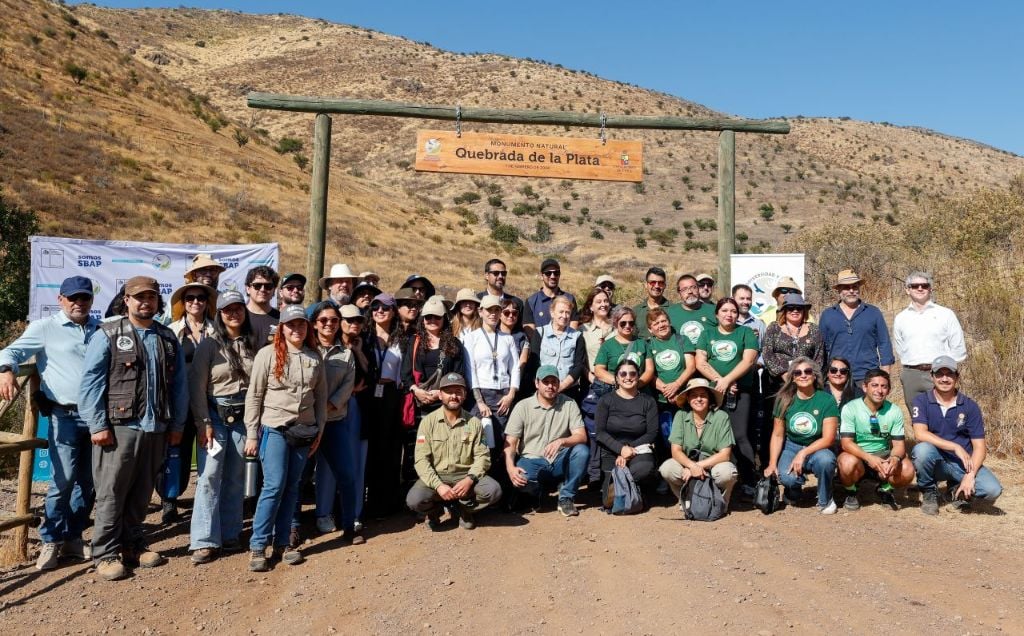
In early March, the official inauguration of the Quebrada de la Plata Natural Monument took place, marking it as the first area to be integrated into the new National Protected Areas System (SNAP) established by Law 21.600.
The event, which was open to the public, brought together national and local authorities, academic representatives, and civil society organizations, heralding a milestone for the country’s environmental governance and for the conservation of the Mediterranean ecosystem in central Chile.
This protected area, located in the commune of Maipú and owned by the University of Chile, previously held the designation of Nature Sanctuary, but after undergoing an homologation process under the new environmental legislation, it has now achieved the status of Natural Monument, one of six protection categories within the SNAP.
This process represents the first agreement between the State and a landowning institution for the inclusion of a protected area into the system, reflecting the collaborative approach promoted by the new environmental governance framework.
Nicola Fiore, Vice Dean of the Faculty of Agronomic Sciences at the University of Chile, emphasized the symbolic and strategic significance of this milestone: «It is a very powerful signal. It recognizes our university’s historic commitment to biodiversity conservation and paves the way for collaboration between the State and academia to be a cornerstone of the new System.»
The event also saw participation from social organizations, local residents, and nearby communities, showcasing the territorial and participatory approach that the SBAP encourages in biodiversity management.
A Historic Natural Monument
The Quebrada de la Plata Natural Monument spans 1,110.7 hectares located in the first mountain range of the Coastal Range, approximately 30 kilometers southwest of Santiago, within the Priority Conservation Site of El Roble.
The area hosts a significant portion of the biodiversity of the Metropolitan Region, including nearly 966 species of plants, animals, fungi, and lichens, many of which are endemic to Chile’s central Mediterranean ecosystem. Notable among these is the guayacán (Porlieria chilensis), a species classified as vulnerable.
Moreover, Quebrada de la Plata is part of one of the 35 biodiversity ‘hotspots’ worldwide, characterized by high levels of endemism.
Its emblematic species include the chagual, the chagual butterfly, as well as trees and shrubs characteristic of sclerophyllous forest such as quillay, peumo, and litre. In terms of fauna, the area is home to native species like the turca, the Chilean iguana, and the rulo toad, among others.
Additionally, the environmental conditions of the territory—drier on the north-facing slopes and wetter on the south-facing slopes—create a diversity of microhabitats that enhance its ecological value.
The area also safeguards eight conservation objects, including its water system, soils and subsoils, the peumo and guayacán forests, as well as elements of natural and cultural heritage, such as historical lime kilns from the 19th century and vestiges of past mining activities.
The recent history of the area reflects the coordinated action between local communities, the municipality, and academia. Between 2012 and 2015, the site was illegally exploited by a mining company that undertook extractive activities with significant environmental impact. This prompted institutional and social mobilization, culminating in its declaration as a Nature Sanctuary in 2016.
However, on the same day that the declaration was approved by the Council of Ministers for Sustainability, a forest fire affected approximately 875 hectares, equivalent to 79% of the area’s surface.
Since then, the Faculty of Agronomic Sciences at the University of Chile has engaged in sustained socio-ecological restoration efforts, reforestation, soil and water conservation, environmental education, and scientific research.
In line with measures for wildfire prevention, the FIREWATCH Early Fire Detection System was implemented in May 2023 in the area.
This system features a 24-meter-high tower and image recognition software capable of detecting fires at their earliest stages from a distance of up to 20 kilometers. It operates on optical sensors that continuously monitor for smoke presence.
The system works 24/7 over an area of up to 125,000 hectares. This technology represents the first early wildfire detection system of its kind installed in the Metropolitan Region.
Currently, access to the area is restricted and requires prior authorization, as part of protective measures against threats such as unauthorized entries, wildfires, and illegal hunting.
Quebrada de la Plata: Natural, Scientific, and Educational Heritage
The homologation of the Quebrada de la Plata Nature Sanctuary to the category of Natural Monument marks the effective commencement of operations by the Biodiversity and Protected Areas Service (SBAP).
The territory significantly represents the Mediterranean ecosystem of the Metropolitan Region, corresponding to the Matorral and Sclerophyllous Forest Region. Within this classification, various vegetation formations are recognized in the area, including:
- Coastal Mediterranean Sclerophyllous Forest of Cryptocarya alba and Peumus boldus.
- Andean Mediterranean Sclerophyllous Forest of Quillaja saponaria and Lithraea caustica.
- Interior Mediterranean Thorny Forest of Acacia caven and Prosopis chilensis.
These formations give rise to scrubland and wooded vegetation of high ecological and scientific value.
For the Faculty of Agronomic Sciences at the University of Chile, the area also serves as a strategic space for scientific research, teaching, and professional training.
In this regard, Vice Dean Nicola Fiore highlighted the importance of its conservation: «Quebrada de la Plata is a natural heritage of Chile. Its preservation not only safeguards the biodiversity of the Mediterranean ecosystem, one of the most threatened in the country, but also constitutes a fundamental space for scientific research, teaching, and training professionals committed to sustainable development and responsible resource management.”

Law SBAP 21.600 and the Natural Monument Category: Key Aspects
Law 21.600 establishes the Biodiversity and Protected Areas Service (SBAP) and the National Protected Areas System (SNAP), integrating public, private, and indigenous protected area management into a single institutional framework for land, marine, and continental zones.
The system aims to manage the conservation of biodiversity effectively, comprehensively, and equitably by incorporating mechanisms for public participation, management instruments and funding, as well as strategies for alignment with public policies.
A key objective of SNAP is to integrate the ecosystem services of protected areas into national, regional, and local development plans and policies, linking them with spatial planning instruments to ensure the sustainable management of biodiversity and natural resources.
The law also establishes the creation of public-private regional advisory committees composed of authorities, academics, private protected area owners, social organizations, local and indigenous communities, and representatives from the productive sector, to strengthen governance and multi-sectoral participation.
The Citizen
La entrada Maipú: Quebrada de la Plata Becomes the First Natural Monument in the New National Protected Areas System se publicó primero en El Ciudadano.
🔥 Ver noticia completa en ElCiudadano.cl 🔥