El Ciudadano
Original article: Estado profundo británico, BP, Shell y la lucha eterna por el petróleo de Irán
By Bruno Sommer
THE GHOST OF ANGLO-PERSIAN: A CENTURY OF HISTORY
To understand what is happening today in Iran, one must go back to 1901, when a London millionaire named William Knox D’Arcy received a 60-year concession from the Shah of Persia to exploit oil in most of the country. In exchange, Persia would receive a mere 16% of the annual profits.
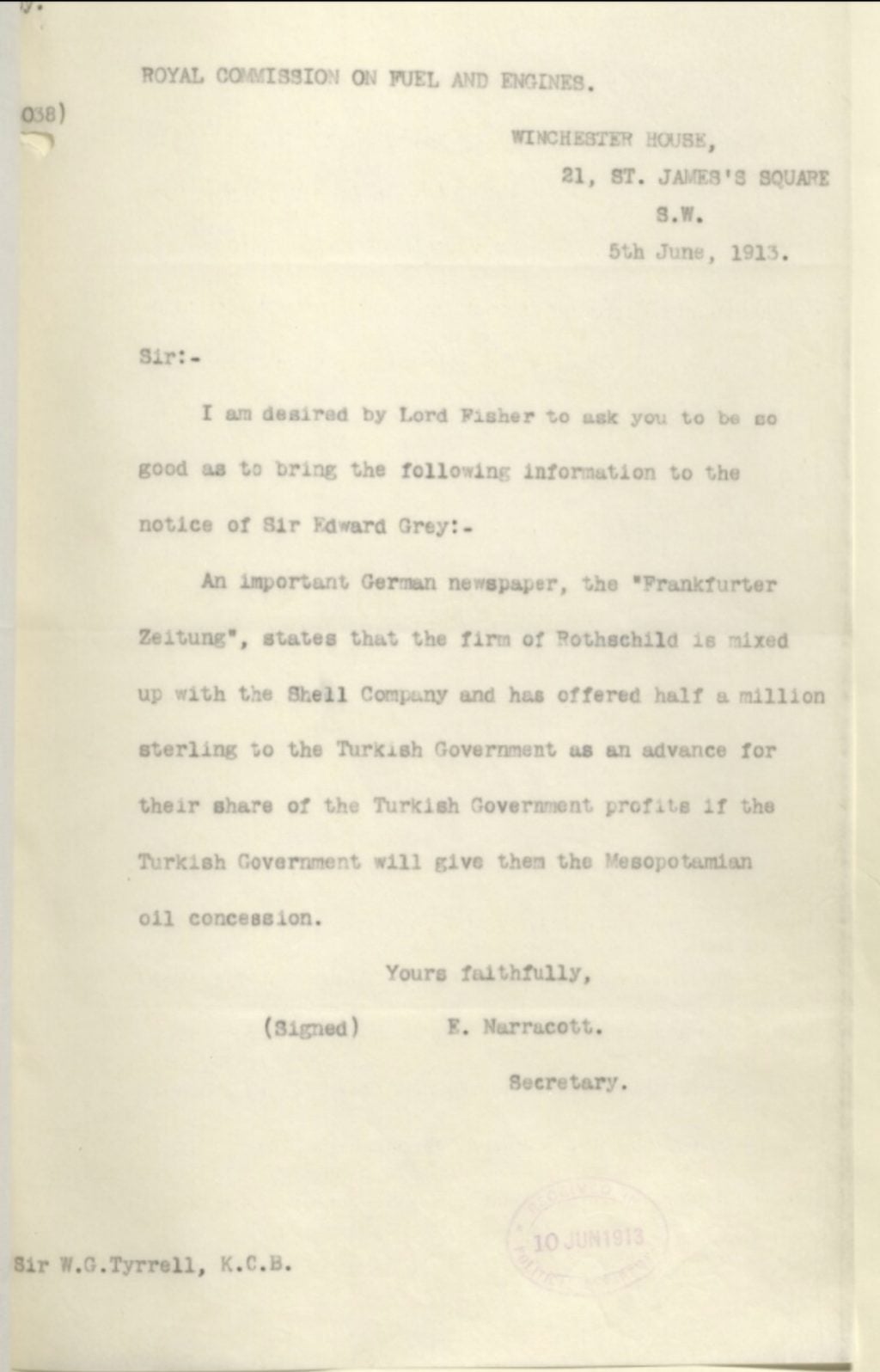
The exploration proved costly, and D’Arcy had to sell most of his rights to a Glasgow-based syndicate, Burmah Oil Company. The financial web surrounding these early steps is complex and opaque. What is documented by declassified British government files is that the Rothschild family was already deeply involved in the struggle for Middle Eastern oil at that time. A 1913 document (IOR/L/PS/10/300) reveals that «the Rothschild firm» offered half a million pounds to the Turkish government for concessions in Mesopotamia, in association with Shell Company. The Rothschilds, who already controlled a significant portion of global oil trade through their refineries in the Caucasus and agreements with Royal Dutch Shell, saw the region as a natural extension of their energy empire. While official narratives attribute ownership of Burmah Oil to the Scottish family Cargill, the Rothschild’s presence in the regional framework is undeniable and suggests a network of financial influences that deserves further investigation.
The true turning point came in 1914. Winston Churchill, then First Lord of the Admiralty, decided to convert the British fleet from coal to oil to gain a strategic advantage over Germany. His bold solution was for the British government to purchase 51% of the shares of the Anglo-Persian Oil Company, effectively nationalizing it. Moreover, Churchill was soon hired as a consultant to lobby the government on behalf of the company. The British state and the corporation merged into a single entity serving the Empire.
The defense of these interests was not only economic but also military. Britain created the South Persia Rifles, an armed force to protect its oil facilities from local tribes. They also bribed Arab sheikhs and tribal chiefs with money and stock to secure control over the Khuzestan region, where the Abadan refinery, the world’s largest for decades, was built.
The climax of this first era occurred in 1953. When Iranian Prime Minister Mohammed Mossadegh nationalized the Anglo-Iranian Oil Company (renamed since 1935), the British response was immediate and lethal. London organized an international boycott of Iranian oil and, together with the CIA, orchestrated a coup d’état that overthrew Mossadegh. After the coup, an international consortium was formed to exploit Iranian oil, of which BP (name since 1954) held the majority stake. The British government did not sell its stake in the company until 1987, but by then, the connections between financial elites, the crown, and the corporate world were already indissoluble.
THE SEVEN SISTERS: THE OLIGOPOLY THAT DIVIDED IRAN’S OIL
The term «Seven Sisters» was coined in the 1950s by Italian businessman Enrico Mattei, president of ENI, to refer derogatively to the seven oil companies that operated as a global cartel, controlling production, refining, and distribution of crude oil worldwide since the mid-20th century.
The Seven Sisters included:
- Standard Oil of New Jersey — later Exxon, now part of ExxonMobil
- Royal Dutch Shell — Anglo-Dutch company emerged from the 1907 merger
- Anglo-Iranian Oil Company (AIOC) — originally Anglo-Persian Oil Company, later British Petroleum (BP)
- Standard Oil of New York — known as Mobil, now integrated into ExxonMobil
- Standard Oil of California — later Chevron
- Gulf Oil Corporation — absorbed by Chevron in 1985
- Texaco — also absorbed by Chevron in 2001
Three of these companies (Exxon, Mobil, Chevron) were direct heirs of John D. Rockefeller’s empire, whose Standard Oil was broken up in 1911 under U.S. antitrust laws.
The relationship of the Seven Sisters with Iranian oil reached its peak after the 1953 coup, organized by the CIA and MI6 to overthrow democratically elected Prime Minister Mohammad Mossadegh, who had nationalized the Anglo-Iranian Oil Company in 1951.
After Mossadegh’s overthrow, the Iran Consortium (1954) was created, an agreement whereby the Seven Sisters resumed benefiting from the exploitation of Iranian oil. The share distribution was as follows:
- British Petroleum (heir of AIOC): 40%
- Royal Dutch Shell: 14%
- Gulf Oil: 8%
- The four Aramco partners (Standard Oil of California —Chevron—, Standard Oil of New Jersey —Exxon—, Standard Oil of New York —Mobil—, and Texaco): 8% each
- Compagnie Française des Pétroles (later Total): 6%
This consortium, operating as a true cartel, controlled about 85% of the known oil reserves in the world from the mid-1940s until the 1973 crisis. The new regime established after the coup allowed these companies to exploit Iranian fields without considering the interests of the Iranian people, who would not regain effective control over their oil until the Islamic Revolution of 1979.
EUROPEAN SUPPORT: GERMANY AND FRANCE CLOSE RANKS WITH TRUMP
Today, this historical framework explains why Germany and France, alongside the United Kingdom, have closed ranks with the United States and Israel in the attack against Iran, despite superficial diplomatic tensions and their official declarations not to participate in the bombings. The historical ties of their banking elites prevent them from acting otherwise, as revealed in the statements from the political leaders of each nation involved.
On February 28, the day after the attacks began, the leaders of France, Germany, and the United Kingdom — Emmanuel Macron, Friedrich Merz, and Keir Starmer — issued a joint statement outlining Europe’s position. They condemned «in the strongest terms the Iranian attacks against countries in the region» and asserted: «We do not participate in these attacks, but we are in close contact with our international partners, including the United States, Israel, and regional partners.»
However, diplomatic language conceals a much more compromised reality, especially considering the documented connection between French President Emmanuel Macron and the Rothschild family.
France: Ready to «Participate in the Defense» of Gulf Allies
On Monday, March 2, French Foreign Minister Jean-Noël Barrot went a step further. France declared it was «ready, in accordance with the agreements binding it to its partners and with the principle of collective self-defense as provided by international law, to participate in their defense.» The «partners» referred to include Saudi Arabia, the United Arab Emirates, Qatar, Iraq, Bahrain, Kuwait, Oman, and Jordan, all of which are targets of Iranian missile attacks in retaliation for the U.S.-Israeli offensive.
Barrot, however, slipped a critique, stating that the «unilateral» attacks by the United States and Israel should have been debated in the UN Security Council. A formal objection that does not prevent France from putting its military infrastructure at the disposal of the de facto coalition.
Germany: Celebrating the Attack While Denying Participation
The German case is even more revealing of Europe’s double game. Chancellor Friedrich Merz admitted to being informed of the attacks in advance and had a telephone conversation with Benjamin Netanyahu on the same Saturday. But what was most significant was his statement to his cabinet celebrating the attacks: «The regime of the mullahs is a terrorist regime, responsible for decades of oppression of the Iranian people,» and he stated that he shared the United States’ goals of «ending this destructive regime.»
When asked about the international legality of the attacks, Merz declined to comment: «Now is not the time to give lessons to our partners and allies. Despite our reservations, we share many of their goals.»
German Foreign Minister Johann Wadephul clarified that Germany would not participate «offensively» due to a lack of military resources, but confirmed that its stance is defensive: if German soldiers deployed in the region are attacked, they will defend themselves. A very fine line that, in practice, means that Germany is willing to engage in combat if the war escalates.
United Kingdom: Cession of Bases and the Blair Connection
The government of Keir Starmer has taken the most concrete and committed step. Starmer authorized the United States to use British military bases, including the strategic island of Diego Garcia in the Indian Ocean and RAF Fairford in Gloucestershire, to launch attacks against Iran. Initially, Starmer had rejected Trump’s request but eventually capitulated.
Starmer justifies his action as participating «not at the moment» in the attacks but allowing the infrastructure. The opposition leader, Nigel Farage, has demanded that he take a further step: «The Prime Minister needs to change his opinion on the use of our military bases and support the Americans in this vital fight against Iran.»
But the most concerning connection is not Farage, but Tony Blair. The former British Prime Minister, the architect of the 2003 Iraq invasion (also over nonexistent «weapons of mass destruction»), has resurfaced as a co-manager of Trump’s and Netanyahu’s plan for Gaza. A plan that, according to leaks, contemplates the reconstruction of the territory under the supervision of a «non-political board» reporting to Trump and Blair himself. Journalist Olga Rodríguez sums it up accurately: «a former leader of the first colonial power that appropriated Palestine —the United Kingdom— and the president of the neocolonial power that took over from London as the greatest protector of Israel.»
THE ROTHSCHILDS AND THE RED THREAD OF HISTORY FOR THE NEW FINANCIAL ARCHITECTURE
What connection exists between the Anglo-Persian Oil Company of 1901, the Rothschilds, the support of Germany and France for the attack on Iran, and the reconstruction of Gaza managed by Tony Blair?
To answer that question, it is necessary to unravel the red thread that connects two centuries of history. The Rothschilds emerged as the first major global financial power during the Napoleonic Wars, when Nathan Rothschild orchestrated the shipment of gold bullion to the British army and, according to legend, took advantage of his network of messengers to learn the outcome of Waterloo before anyone else, buying British bonds just before their price surged. That operation symbolizes the origin of a fortune built on war debt and the ability to move capital across borders while armies bled.
The family perfected a strategy that would be repeated for decades: financing all combatants in a conflict simultaneously. During the Franco-Prussian War of 1870, the French and German branches lent money to their respective governments, ensuring profits regardless of the winner. During World War I, the family holding funneled resources to all sides; the Rothschilds in Germany backed the Kaiser, those in England supported the King, and those in France supported the Republic, demonstrating that the business of war does not recognize nations but balance sheets.
Their influence also extended to colonialism and control of strategic resources. In 1875, Lionel de Rothschild lent four million pounds to the British government to purchase the Egyptian stake in the Suez Canal, securing imperial control of the route to India. They supported Cecil Rhodes in the conquest of southern Africa; Rhodes wrote to them: «With you behind me, I can do everything I have said.» In Spain, they financed both liberals and conservatives and, as payment for debts, acquired vast mining empires in Peñarroya and Riotinto, in addition to promoting major railway lines. This same funding pattern in exchange for concessions over natural resources would be replicated decades later when, as documented, the Rothschild firm appeared in 1913 offering half a million pounds to the Turkish government for oil concessions in Mesopotamia in partnership with Shell Company, on the same board where the Anglo-Persian Oil Company —precursor to BP— sought to secure its control over Persian oil.
World War II marked a turning point. The Nazis confiscated the properties of the Austrian and French Rothschilds, and Baron Guy de Rothschild lost his nationality under the Vichy regime, exiling himself to later fight with the Free Forces. Paradoxically, while the family was persecuted, banks and Western corporations such as JP Morgan and Standard Oil maintained business relations with Nazi Germany, evidencing the complex network of interests that has always surrounded major conflicts. After the war and subsequent nationalization of their banks in France, the Rothschilds opted for discretion, focusing on investment banking and advisory work, distancing themselves from direct control of industrial corporations.
The British interest in Iranian oil, far from dissipating with the end of the Empire, has remained relevant to this day through financial and commercial operations that demonstrate the continuity of this strategic link. An eloquent example occurred in 1999 when Royal Dutch/Shell —successor of the Anglo-Dutch network that always competed with BP for control of Middle Eastern hydrocarbons— signed an $800 million contract with the National Iranian Oil Company to develop the Soroush and Nowruz offshore oil fields in the Persian Gulf. This agreement, the first of its kind between Iran and Shell since the Islamic Revolution of 1979, aimed to increase Soroush’s production from 60,000 to 150,000 barrels per day and rehabilitate the Nowruz field to reach 90,000 barrels. At that time, Shell’s representative in Iran stated unequivocally: «There are no limits on investments in Iran and we will participate in any attractive project,» while the Iranian oil minister celebrated that «this cooperation could take the form of partnerships in the global market.»
However, the most revealing proof that British interest in Iranian oil never disappears —but rather adapts to geopolitical circumstances— came in 2012, during a climate of international sanctions against Iran for its nuclear program. Shell then accumulated a debt of $1.4 billion with the National Iranian Oil Company for crude purchases made just before the European Union embargo that came into force on July 1 of that year. The company had continued buying Iranian oil when its competitors had already withdrawn, and by the time the embargo arrived, it found that banking sanctions prevented it from transferring payment to Tehran.
The solution Shell attempted to implement reveals the extent to which large energy corporations are willing to navigate political obstacles to maintain their ties with Iran. The oil company proposed an ingenious barter mechanism: to pay its $1.4 billion debt through a grain supply agreement managed by the U.S. agribusiness Cargill. The plan was for Shell to finance Cargill to deliver grains —wheat, corn, and barley—to Iran at an equivalent value to the debt. Since the sanctions did not explicitly prohibit food deliveries for humanitarian reasons, the operation aimed to bypass banking restrictions while maintaining commercial ties with Tehran.
Sources consulted by Reuters were explicit about Shell’s motivations: «It wants to repay what it owes to NIOC. It wants to maintain friendly relations for the day when sanctions are lifted.» Another witness added: «A barter transaction is the only possible way.» This operation required authorization from the governments of the United States, the United Kingdom, and the Netherlands, creating a dilemma for the authorities: refusing could be interpreted as a deliberate blockade of humanitarian supplies, but approving it would set a dangerous precedent for other companies indebted to Iran. Ultimately, the authorities blocked the deal, and the British government denied Shell authorization for direct bank transfer payment.
By 2013, Shell’s debt to Iran had risen to $2.3 billion due to unpaid interest, and the company acknowledged in its annual reports: «We cannot settle this payment position as a result of applicable sanctions.» However, the accrued amount and attempts to circumvent restrictions demonstrate that, for large oil companies, the door to Iran is never completely closed; it simply remains ajar, awaiting political conditions that will allow business operations that in some cases —like Shell’s— have been in motion for over a century.
The connection with the Cargill family is neither casual nor minor for the purposes of this investigation. As previously documented, Burmah Oil Company —the parent company that financed William Knox D’Arcy and founded the Anglo-Persian Oil Company, precursor to BP— was owned by the Cargill family. That Shell resorted precisely to Cargill in 2012 to attempt to settle its debt with Iran reveals a web of relationships that transcends time and sanctions: the same surnames that controlled the capital making possible the exploitation of Persian oil in the early 20th century appear, a century later, as the chosen vehicle to maintain the financial connection between Western oil companies and Iran.
Cargill’s refusal to participate — «it has its own financial channels to collect and does not need Shell,» according to sources — does not deny the existence of the link but rather confirms it. The agribusiness maintains direct commercial relations with Iran apart from oil companies, and its position on the board is strong enough to choose its partners. The red thread linking the Rothschilds to Anglo-Persian, to Burmah Oil with the Cargills, and to Shell with the grain barter in 2012 is the same one connecting the Napoleonic Wars with 21st-century sanctions, the capacity of certain families and corporations to perpetuate their influence over strategic resources, adapting to regime changes, wars, and sanctions with a plasticity that challenges any attempt of control by the states.
Today, the descendants of those dynasties do not need to sit on the boards of BP or Shell to maintain their influence. A review of BP’s current board composition reveals no surnames like Rothschild, Warburg, or Baring, but cross-shareholdings through giants like BlackRock —whose CEO, Larry Fink, leads the tokenization of assets— and global financial networks ensure that the interests of those historical elites continue to weigh heavily in strategic decisions. This is where history intersects with the present: the same financial network that financed wars, empires, and the exploitation of Persian oil for a century now operates behind the scenes in supporting Germany and France’s attack against Iran —protecting their military and trade ties with Gulf nations— and in the reconstruction of Gaza managed by Tony Blair, a plan that would place the administration of the territory under a technocratic board responsible to Trump and the former British prime minister. Controlling the entire coast of Palestine, under Western domination of Israel and preventing oil transit through the Strait of Hormuz by constructing a pipeline crossing Iran, Iraq, Syria to exit through the Mediterranean is an old project of Western oil elites.
Germany and France: Zionism as a Pretext
The inevitable question is: why do Germany and France, who officially maintain distance from the attacks, end up aligning with the United States and Israel? The answer has multiple layers.
The first is economic: France and Germany have deep commercial and military ties with Gulf nations. France sells weapons and technology to Qatar, the United Arab Emirates, and Saudi Arabia. Germany relies on energy and markets in the region. Protecting those allies means protecting their own interests.
The second is political: the elites of these countries maintain a structural relationship with Israel that transcends changing governments. In the UK, figures from all parties —from conservative Priti Patel (who resigned for secret meetings with Israel and was later promoted) to labor leader Keir Starmer (who calls himself a Zionist)— maintain an unbreakable alignment. In Germany, the Staatsräson (reason of State) implies existential support for Israel. In France, the Jewish community is the largest in Europe and its political influence is significant.
However, the third level, the deepest, is financial. The tokenization of the economy —the conversion of physical assets into tradable digital assets in split seconds— is the new frontier of global capitalism. BlackRock, the world’s largest asset manager, leads this transformation. Its CEO, Larry Fink, has repeatedly stated that tokenization is «the next evolution of financial markets.»
If Iran is destabilized, if its oil and gas come back under Western control, if Gaza is rebuilt with multimillion-dollar investments in infrastructure, energy, and water, who will manage these new assets? The same funds that today lead the tokenization. The same banks that operated in the region a century ago. The same families that have dominated the energy sector for generations.
THE FRACTURE IN EUROPE AND THE COMPLICIT SILENCE
Not all European countries support this strategy. Spain, through its President Pedro Sánchez, has been the only leader to openly condemn the «unilateral military action of the United States and Israel, which represents an escalation and contributes to a more uncertain and hostile international order.» Sánchez calls for an «immediate de-escalation and full respect for international law.»
However, Sánchez’s position is minority. The joint statement of the 27 EU nations, negotiated under intense pressures, merely called for «restraint» without even mentioning the respect for international law, which The New Arab describes as a «mere formality.» The fracture is evident: the three great powers chart the course, and the rest, with exceptions, remain silent.
CONCLUSION: THE ETERNAL WAR FOR CONTROL
What we are witnessing is not a war for «nuclear non-proliferation,» nor even a war for «regional stability.» It is a war for control over Iran’s energy resources and the reconfiguration of the Middle East for the benefit of a transnational network of political and financial elites with roots going back to the 19th century.
The British Empire no longer has official colonies, but its «deep state,» embodied in BP, in banks like the Rothschilds, in former prime ministers like Tony Blair, and in politicians from all parties aligned with Israel, continues to fight to maintain control over the oil that once flowed for Churchill’s Royal Navy.
Germany and France join this struggle not out of democratic conviction or solidarity with Israel, but because their economic and financial elites are intertwined in the same transnational framework. The tokenization of the economy promises to be the ultimate tool for perpetuating this control: the physical assets of Iran, Gaza, and all of the Middle East could become digital tokens that large financial families could buy, sell, and manage without getting their hands dirty with local politics.
Meanwhile, the peoples of the United States, Israel, the United Kingdom, France, and Germany are called to mobilize. But perhaps the real challenge is not only to stop this war, but to unravel and challenge the power networks that have decided the fate of entire nations from the opacity of board rooms and private dinners in London, New York, or Tel Aviv.
CLARIFICATION NOTE ON HISTORICAL SOURCES
Declassified records from the British government (IOR/L/PS/10/300) reveal that in 1913, while the Anglo-Persian Oil Company —precursor to BP— was in gestation, the Rothschild firm was actively involved in oil negotiations in the region, offering half a million pounds to the Turkish government for concessions in Mesopotamia, in partnership with Shell Company, according to German press reports of the time. This evidence confirms that major European financial families participated in the struggle for control of Middle Eastern hydrocarbons from the dawn of the industry.
As for Burmah Oil Company, the parent company that financed D’Arcy and founded the Anglo-Persian Oil Company, non-academic sources suggest that it may have been under the financial umbrella of the Rothschild family. However, the official histories of the company attribute its ownership to the Scottish family Cargill. What is documented is that the Rothschilds were actively involved in the region’s oil landscape at the same time, as evidenced by the aforementioned document.
REFERENCES
The following are the news sources and official documents that support the recent events mentioned in the report:
- Original concession from 1901: This is a historical archive source. The physical document is located in the Archives of the Anglo-Persian Oil Company. It can be consulted through the **BP Archive** at the University of Warwick: (https://warwick.ac.uk/services/library/mrc/archives_online/bp/)
- Document IOR/L/PS/10/300 (1913): A declassified British government archive available in the **Qatar Digital Library / British Library**. It can be consulted online at: (https://www.qdl.qa/en/archive/81055/vdc_100023517867.0x000002) *(Note: Requires navigation in the catalog)*
- Official history of Burmah Oil (Cargill family): Academic reference available at **Grace’s Guide**: (https://www.gracesguide.co.uk/Burmah_Oil_Company)
- Churchill College archives, Cambridge: These physical documents are at the **Churchill Archives Centre**: (https://archives.chu.cam.ac.uk/)
- South Persia Rifles and operations in Khuzestan: Files from the British Foreign Office (FO 371). They can be accessed at the **National Archives (UK)**: (https://discovery.nationalarchives.gov.uk/)
- Coup against Mossadegh in 1953: Declassified CIA files available at the **National Security Archive** of George Washington University: https://nsarchive.gwu.edu/briefing-book/iran/2017-08-08/cia-coup-iran-1953-declassified-documents-show-trump
- BP privatization (1987): Documents available at the **BP Archive**, University of Warwick: (https://warwick.ac.uk/services/library/mrc/archives_online/bp/)
- Joint statement Macron, Merz, Starmer (Feb 28, 2026): Anadolu Ajansı. Link: (https://www.aa.com.tr/en/europe/france-germany-uk-say-they-didn-t-participate-in-strikes-on-iran-condemn-iranian-attacks-on-regional-countries/3843667)
- France willing to «participate in defense» (Mar 2, 2026): The Times of Israel. Link: (https://www.timesofisrael.com/france-ready-to-take-part-in-defense-of-gulf-countries-and-jordan-against-iran/)
- Barrot criticizes «unilateral» attacks (Mar 3, 2026): The New Arab. Link: (https://www.newarab.com/news/france-criticises-unilateral-us-israel-strikes-iran)
- Merz informed in advance (Mar 1, 2026): Reuters Link: es.marketscreener.com/noticias/merz-de-alemania-mantuvo-una-conversaci-n-telef-nica-con-netanyahu-de-israel-el-s-bado-seg-n-un-fun-ce7e5cdfd08ef32d
- Merz celebrates the attacks (Mar 2, 2026): Anadolu Ajansı. Link: (https://www.aa.com.tr/en/europe/) *(search for “German Chancellor Scholz: Iran’s regime is terrorist, must be stopped”)*
- Merz refuses to comment on legality (Mar 2, 2026): The Times of Israel. Link: (https://www.timesofisrael.com/scholz-refuses-to-comment-on-legality-of-strikes/)
- Wadephul: Germany will defend itself if attacked (Mar 3, 2026): Deutschland.de. Link: (https://www.deutschland.de/en/news/germany-defensive-stance-iran)
- Starmer authorizes British bases (Mar 1, 2026): LBC. Link: (https://www.lbc.co.uk/news/starmer-authorises-british-bases-iran-strikes/)
- Starmer: «We won’t participate for now» (Mar 2, 2026): Vanguard. Link: (https://www.vanguardngr.com/2026/03/uk-wont-join-air-strikes-on-iran-starmer/)
- Farage urges Starmer to support the U.S. (Mar 3, 2026): LBC. Link: (https://www.lbc.co.uk/news/farage-starmer-uk-bases-iran/)
- Tony Blair manager of Gaza (Feb 15, 2026): Diari ARA. Link: (https://www.ara.cat/internacional/trump-netanyahu-tony-blair-gestio-gaza_1_5328474.html)
- [^19]: **Olga Rodríguez on Blair (Feb 16, 2026): ElDiario.es. Link: (https://www.eldiario.es/opinion/tony-blair-hombre-trump-gaza_129_11847541.html)
- Rothschild in the oil landscape (1913): Same link as [^2]
- Trade ties Europe-Gulf (Mar 4, 2026): The New Arab. Link: (https://www.newarab.com/analysis/gulf-states-deepen-ties-europe-amid-iran-tensions)
- British elites aligned with Israel (Jan 12, 2026): Analysis by Daily Sabah / Pars Today. Original link unavailable; can search «UK’s political elite and the ‘structural problem’ of support for Israel» in the archives of both media.
- Larry Fink and tokenization (2025): BlackRock. Link: (https://www.blackrock.com/corporate/investor-relations/larry-fink-chairmans-letter)
- Sánchez condemns unilateral attacks (Mar 1, 2026): Diari ARA. Link: (https://www.ara.cat/internacional/sanchez-condemna-atacs-unilaterals-eua-israel-iran_1_5334567.html)
- EU statement as a “mere formality” (Mar 2, 2026): The New Arab. Link: (https://www.newarab.com/news/eu-calls-restraint-iran-strikes-avoids-international-law)
- Document IOR/L/PS/10/300 (text citation): Same link as [^2].
- Corley, T.A.B. “History of Burmah Oil” (1983): Bibliographic reference available in academic bookstores and university libraries. ISBN: 978-0434154708.
La entrada The British Deep State: BP, Shell, and the Ongoing Struggle for Iran’s Oil se publicó primero en El Ciudadano.
🔥 Ver noticia completa en ElCiudadano.cl 🔥