El Ciudadano
Original article: A 50 años del golpe, Argentina desborda las calles y lanza una advertencia a Milei
Images captured on Tuesday in Buenos Aires and across Argentina showcased a powerful demonstration as the nation marked 50 years since the March 24, 1976 coup d’état that ushered in the bloodiest civic-military dictatorship in its history. A massive crowd flooded the streets and avenues, uniting to declare «Never Again.»
However, the commemorative events were not just about repudiating the past; this vast mobilization served as a clear warning to the ultraright government of Javier Milei, which has downplayed the crimes committed during the state terrorism era and has interrupted or defunded public policies related to memory and human rights.
According to El Destape, the rally was «cross-sectional, involving a wide range of political parties and sectors—transgenerational and transclassistic.»
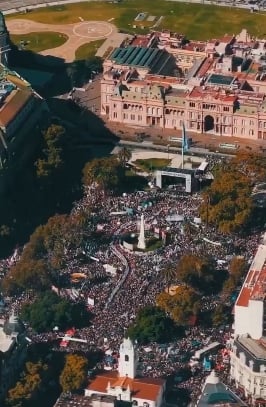
This was not a sectorial march nor a regrouping of traditional progressive forces. Instead, it was a massive public mobilization that transformed historical grief into a collective affirmation in the present.
“As if it were a parenthesis in a prolonged cycle of bad news, the atmosphere among the protesters felt much more festive than mournful,” described journalist Diego Genoud in his coverage for an Argentine media outlet.
“With a president like Javier Milei, a vice like Victoria Villarruel, an extreme-right government that despises and punishes its opponents, and an economy that is stagnant, hundreds of thousands of people left their homes to gather in plazas across the country,” he recounted.
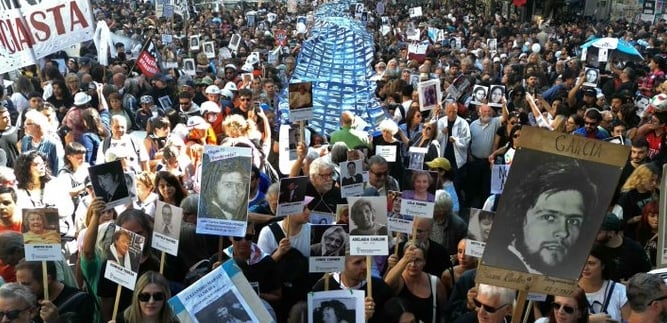
As evidenced by records shared on social media, the streets of Argentina once again served as a thermometer for a society that, 42 years after the return to democracy, is unafraid to call its leaders to account in public spaces. The mobilization, as the analysis pointed out, “was characterized by a social tide that did much more than repudiate a dark and criminal era.”
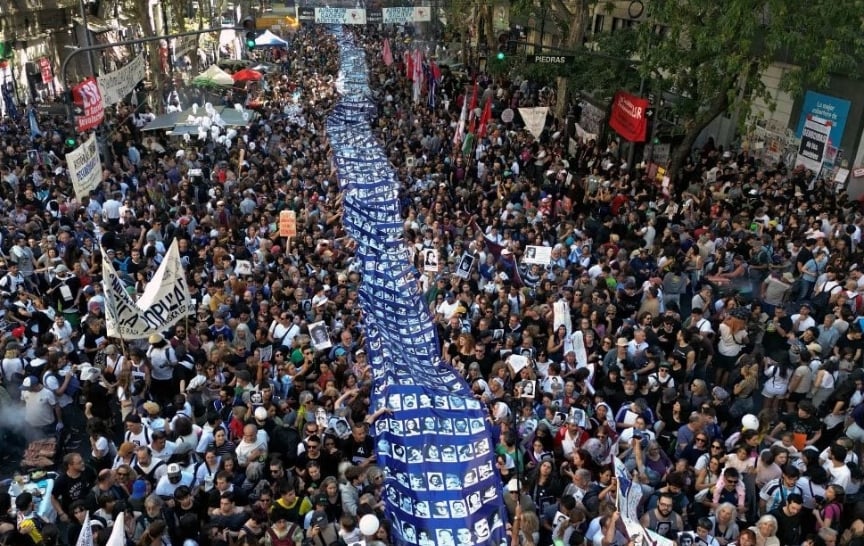
The Warning Milei Cannot Ignore
Although the historical slogan of human rights organizations—»Memory, Truth, and Justice»—remained the primary banner, the multitude, which made walking near the Plaza de Mayo impossible, carried a clear message: a rejection of the so-called “libertarian” revisionism, which has minimized the events of a coup d’état that left thousands disappeared and dead, insisting that it is time to turn the page.
March 24, 1976 marked the beginning of Jorge Rafael Videla’s dictatorship, lasting until 1983 and resulting in 30,000 disappeared persons, a number emblematic and upheld by the Mothers and Grandmothers of Plaza de Mayo.
“Clearly oppositional, the march didn’t expect anything from Milei and the group occupying the Casa Rosada,” Genoud emphasized in his reporting. “But it undoubtedly sent a message against the president,” he noted.
He pointed out that since Javier Milei took office in December 2023, “his repressive government and his pack have unleashed countless forms of violence, including the glorification of the dictatorship and the trivialization of state terrorism,” and furthermore, “they have sown much hatred” in the Southern nation.
In response to the denial of the 30,000 disappeared, the streets of Buenos Aires echoed the chant “Where are they?” and the faces of the fallen multiplied endlessly.
“In the face of the Milei-supporting youth, now afflicted by libertarian unemployment, March 24 showcased a new militant generation willing to experience their struggle against the extreme right,” he emphasized.
“No One Thinks Milei Made It to the Presidency Alone”
According to the journalist, this overwhelming rejection from the crowd serves as a warning for the powers that support Milei and benefit from him, even if they try to ignore it.
He pointed out that the massive mobilization on Tuesday also constituted a direct warning to the ultraright president, a message to those in power who back him, and a challenge for an opposition still trying to find its path and tone.
“No one thinks Milei got to the presidency on his own. Nor that the measures he implements and the laws he passes are mere personal whims: they are part of the conditions set by Argentine elites for at least a quarter of a century and required an interpreter,” he argued.
In this context, the journalist drew a historical parallel that resonated on a day dedicated to memory: “Someone capable of executing a program remarkably similar to what the dictatorship imposed with blood and fire, with Alfredo Martínez de Hoz as economy minister,” he indicated.
The conclusion is clear: “Milei is a tool, an employee of that de facto power that decided to use him as a vehicle for its ambitions.”
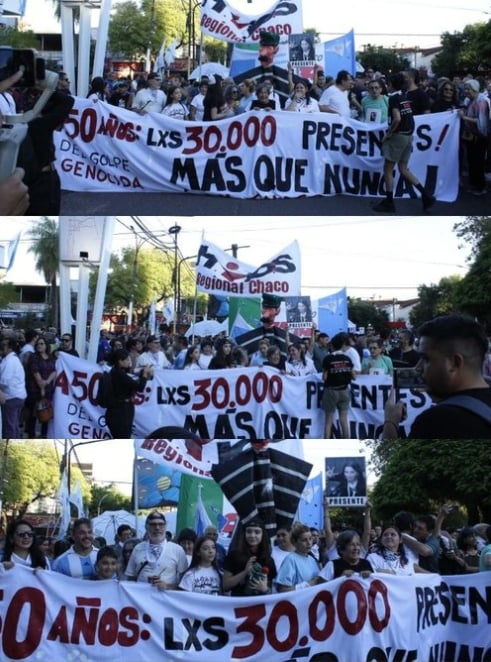
A Stronger Opposition to Interpret Argentinians’ Demands
In his analysis, Diego Genoud focused on a collateral effect of the libertarian strategy: the rebuilding of a tougher opposition.
“Milei and his group have shown a willingness for combat that was absent in macrismo,” he argued, stating that “unintentionally, the president and his faction are creating a tougher opposition.”
In his view, the «libertarian» government, with its confrontational style, has forced opposition spaces to step out of a comfort zone that had been characterized for years by gradualism and consensus-building.
In his piece for El Destape, he directly called on the opposition political leadership, demanding their ability to interpret social events like the massive mobilization for the 50th anniversary of the coup d’état.
“The political opposition has reasons to believe in a new state of affairs, indicating Milei’s fatigue amidst a growing sense of frustration,” he stated. However, he stressed that the opposition “also has a challenge: to interpret the tone and demands that the march against the coup incorporated into the political scene.”
“It takes more than just translating or regulating these demands. We must open our eyes to what is happening. Tune in to express the new that can emerge from a historical demand,” he concluded.
Fifty years after the coup, Argentina has again demonstrated that its memory is also a driving force for the future. The warning to Milei and the powers that support him was sealed in every step of a crowd that took to the streets to loudly declare «Never Again» to the past, defending their rights and demands.
La entrada 50 Years Since the Coup: Argentina’s Streets Erupt in Protest Against Milei’s Government se publicó primero en El Ciudadano.
🔥 Ver noticia completa en ElCiudadano.cl 🔥