El Ciudadano
Original article: ¿Netanyahu no tiene límites? Analizando el asesinato del padre Pierre Al-Rah
By Lisandro Prieto Femenía, Writer, Educator, and Philosopher
“Truly I tell you, whatever you did for one of the least of these brothers and sisters of mine, you did for me.” — Matthew 25:40 (Jerusalem Bible).
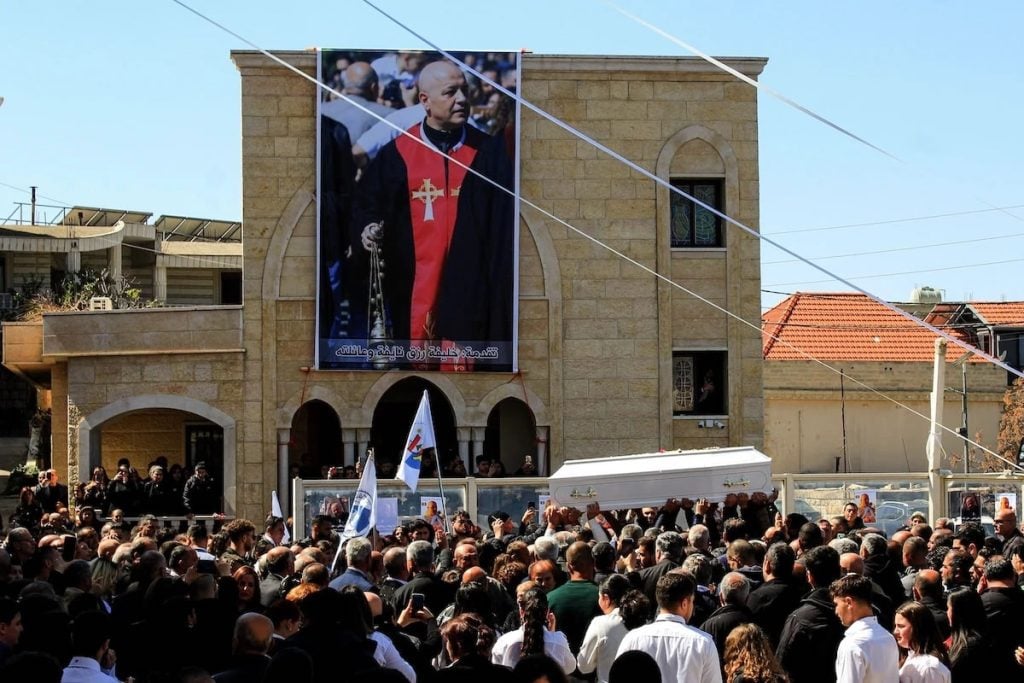
The assassination of Father Pierre Al-Rah, a Maronite parish priest from the village of Klayaa (Lebanon, in the photo), transcends traditional war reporting to raise profound questions about the value of life and the enduring presence of evil throughout human history.
Father Al-Rah was killed on March 9, 2026, amidst Israeli artillery fire while he was aiding an injured parishioner. This act cannot be dismissed as mere collateral damage in the complex geopolitical tensions between states and insurgencies.
On the contrary, this violent and targeted crime against a man who wielded only prayer and care highlights a crisis of otherness that Christian theology and philosophy have long observed: the destruction of the body that aids the fallen signifies an attempt to eradicate the last ethical barrier remaining on the battlefield, namely, the responsibility for one’s brother.
In his influential work, “Totality and Infinity,” Emmanuel Levinas posits that the encounter with the face of the other serves as the foundation of all ethics, a call to respond to their vulnerability.
Father Al-Rah embodied this response radically by refusing to abandon his land and community, disregarding evacuation orders that sought to reduce his existence to a mere logistical variable.
By deciding to remain in Klayaa, the priest was not engaging in superficial political rebellion; he was asserting a spiritual resistance based on love for his roots and the duty to support those without a voice. His sacrifice reminds us that, in the face of a logic of force that seeks to homogenize territory through forced displacement, the physical presence of the just becomes an unbearable obstacle for power.
Furthermore, it is revealing how the state of Israel operates with a sense of omnipotence concerning the Catholic faith in the region.
There is no genuine geopolitical, territorial, or ideological dispute between the people of Israel and the Maronite community or the Vatican that justifies such attacks. However, the impunity with which ancestral Christian villages are bombed reflects an arrogance that Michel Foucault would identify as the exercise of biopower in its purest form: the right to “make live or let die.”
This omnipotence manifests in the belief that any life not aligned with its immediate security goals is expendable. In “Discipline and Punish,” Foucault details this nature of power, which recognizes no moral boundaries, stating that “power is exercised not so much by the right of death, but as the management of life, of biological processes, of bodies. However, in war, this power over life is inverted into the technical necessity of massive death” (Foucault, M., 2002, Discipline and Punish, p. 138, Siglo XXI. Originally published in 1975).
This brazen sense of omnipotence allows the aggressor’s military to disregard the sacredness of places of worship and the figures of religious ministers. By murdering Al-Rah, they did not eliminate a combatant, but instead deliberately struck at the heart of a peaceful community that, due to its Maronite-Catholic identity, stands outside the direct conflict.
It is a manifestation of hybris—excess—that does not recognize Catholicism as a sacred interlocutor, but rather as a geographical element that can be removed at will. The priest’s death demonstrates that, for the Israeli war machine, the faith of the “other” is irrelevant in light of the urgency of their expansion and control, a stance that fractures any possibility of genuine inter-religious dialogue.
Moreover, this overreach, which dismisses the specificity of faith and the dignity of individuals, was sharply critiqued by Joseph Ratzinger. For Benedict XVI, when reason divorces from ethics and submits to the will to dominate, politics becomes a structure of sin.
In his encyclical “Caritas in Veritate,” the former pope warned against the danger of a technique that believes itself self-sufficient: “Technique is a profoundly human fact, linked to man’s freedom. It manifests and confirms the dominion of the spirit over matter. However, technique—when it becomes the only criterion for truth and action—tends to eliminate the moral dimension of man, reducing justice to mere technical or military efficiency” (Benedict XVI, 2009, Caritas in Veritate, n. 68-70, Libreria Editrice Vaticana).
Thus, the bombing of Klayaa is the practical execution of this blindness. Al-Rah, in trying to save an injured person, performed an act of “caritas” that transcended the logic of war. It is precisely for this reason that Ratzinger asserted in “Deus Caritas Est” that a state attempting to suppress this love is heading towards tyranny. The priest’s death represents the triumph of “instrumental reason” over “the reason of the heart,” an arrogance that feels entitled to shoot at charity itself because it offers no strategic advantage.
This architecture of desolation is compounded by the frontal denunciation the Pope Francis has aptly made regarding the “globalization of indifference” and the obsolescence of the concept of “just war” in modernity. For him, the violation against any human being is not merely a ballistic error, but a symptom of a culture that has stopped mourning for the other.
In his encyclical “Fratelli Tutti,” the pope sternly underscored that “every war leaves the world worse than it found it. War is a failure of politics and humanity, a shameful capitulation, a defeat in the face of the forces of evil. Let us not linger in theoretical discussions; let us touch the wounds, let us touch the flesh of those who suffer harm” (Francis, 2020, Fratelli Tutti, n. 261, Libreria Editrice Vaticana).
In this light, the Israeli attack on the Lebanese Catholic community is a slap in the face of universal brotherhood. The arrogance of the aggressor feeds off the “anesthetic” provided by technical distance; death occurs from a screen or a coordinate, ignoring that a human fabric, like that of the Maronite community, has guarded peace for centuries.
Remember, Francis insisted that “the name of God cannot be used to justify war,” which makes the silence or tepid response to the brutal murder of a man of faith aiding his neighbor a betrayal of humanity itself. Israel’s aggression in Klayaa is the embodiment of a “culture of discard” pushed to its ballistic extreme, where the life of a priest is dismissed as mere noise on a radar of targets.
At this juncture in reflection, it is crucial to assert that the Catholic tradition has anchored its ethics in the capacity for forgiveness and the evangelical command to turn the other cheek, yet it would be exegetically and morally erroneous to confuse this spiritual disposition with passive acceptance of injustice.
Christian forgiveness is not amnesia nor capitulation before injustice: rather, it is a force that demands truth in order to be authentic. In this regard, the Catholic philosopher Gabriel Marcel reminded us that creative fidelity is not inertia, but an active response to the presence of the other. Turning the other cheek does not imply silence in the face of the violation of the limits of tolerance and respect that the Israeli government destroys with each incursion upon civil and religious populations.
Moreover, St. Augustine, in his reflections on justice, is clear when he declares that “hope has two beautiful children: their names are indignation and courage. Indignation to see how things are, and courage to see that they do not remain as they are” (Augustine of Hippo, Sermon 46, On Pastors).
Evidently, the Catholic faith does not call for a quietism that validates the impunity of the powerful. Silence in the face of Father Al-Rah’s death is not a virtue, but an omission that betrays the commitment to life. Prayer is the driving force of the just, but public testimony is their duty before history.
When the limits of human coexistence are pulverized by a military arrogance that finds no counterbalance, forgiveness becomes a parody unless it is accompanied by a firm denunciation of excess. We Catholics have learned to forgive our executioners, but that same love for neighbor compels us to raise our voices against the machinery that creates executioners and annihilates innocents, for the respect for the sacred—both in the temple and in the person—is a boundary that no state, however powerful it assumes to be, has the right to cross.
At this point, it is imperative to analyze the reaction of the Holy See to this crime. Pope Leo XIV, while expressing “deep sorrow,” seems to have opted for a rhetoric of neutrality that borders on moral indifference.
By referring to the blood of the priest as a “seed of peace,” the pontiff resorts to a theological metaphor that dilutes the political responsibility of the aggressors. This posture evokes Hannah Arendt’s warning in her work “Eichmann in Jerusalem,” in which she analyzes how administrative language can obscure the reality of atrocity: “The painful truth of the matter was that this was not a monstrosity, but something located at the very margins of everyday life, something that could happen to anyone” (Arendt, H., 2003, Eichmann in Jerusalem, p. 368, Lumen. Originally published in 1963).
The omission of an explicit condemnation of the aggressor state by Leo XIV shifts the conflict to the realm of inevitable fatality. Francis, in his interventions regarding similar conflicts, has reminded us that one cannot be neutral in the face of flagrant injustice. Rome’s insistence on a generic peace indirectly validates the omnipotence of the aggressor, as it fails to establish a firm ethical limit from Peter’s authority. As Benedict XVI reminded us, “justice is the object and the intrinsic measure of all politics,” and an ecclesiastical policy that remains silent in the face of blatant injustice renounces its mission.
Karol Wojtyla, in “Person and Action,” articulates a truth that resonates powerfully in the presence of the lifeless body of the parish priest from Klayaa: “The human person possesses a value that is not reducible to anything, a value that resides in its very being and that constitutes it as an end in itself, never as a means to external ends” (Wojtyła, K., 2011, Person and Action, p. 142, Biblioteca de Autores Cristianos. Originally published in 1969).
The crime against the priest while exercising his ministry is the absolute denial of this premise. Al-Rah was turned into a “means” to deliver a message of terror. The dehumanization of the adversary allows for the stripping of their status as a person, reducing them to a mere demographic obstacle to be removed by force.
The blood of Father Pierre cries out not for vengeance but for a truth that refuses to be buried under the rubble. The dismantling of Christian presence in its very cradle is not a fortuitous event but a phenomenon that intertwines military arrogance with a territorial ambition that recognizes no human or sacred limits.
This reality compels us to question whether the right to land has ceased to be an inherent dignity of every people that inhabits and loves it, transforming instead into an arbitrary concession by those with the technical means of displacement.
The normalization of the deaths of those who heal wounds on the battlefield should raise a piercing question about the state of our humanity: to what extent has silence before the martyrdom of the neighbor gangrened the consciousness of an international community that sees the destruction of the ancestral as a necessary formality for security?
Thus, it is unavoidable to address the metaphysical justification for Israeli violence against a community with which it has no geopolitical conflict.
How can the ethical legitimacy of a state that, intoxicated by a sense of superpower, systematically annihilates the faithful of a creed alien to its dispute, be upheld if not through an absolute loss of the sense of the sacred and of otherness?
This excess places us before the paradox of a Vatican diplomacy that seems to have exchanged the prophetic voice for a management of suffering stripped of denunciation. In this context, we must ask at what point does the rhetoric of “seeds of peace” become a pious veil that conceals cowardice before worldly power, allowing the sower to be murdered impudently under the indifferent gaze of those who should be its custodians.
In conclusion, dear readers, the death of Pierre Al-Rah serves as a mirror reflecting our own ethical fragility and the final testament of a sacrifice that challenges the validity of words in the face of gunpowder.
If the purest act of charity—the assistance to the fallen—can no longer stop the hand of one who believes they own life and death, international justice has ceased to be an order and has become a fiction that protects the executioner.
Only through a rigorous questioning that names the aggressor and rejects administrative warmth will it be possible to restore the dignity of the person against the coldness of statistics and the arrogance of brute force.
Lisandro Prieto Femenía
Bibliographical references
Aci Prensa. (2026, March 9). Priest dies in bombing in southern Lebanon while helping injured parishioner. https://www.aciprensa.com/noticias/122897
AICA. (2026, March 11). Leo XIV prays that the blood of the slain priest may be the seed of peace for Lebanon. https://aica.org/noticia-leon-xiv
Arendt, H. (2003). Eichmann in Jerusalem: A Study on the Banality of Evil (C. Ribalta, Trans.). Lumen. (Originally published in 1963).
Arendt, H. (2006). On Violence (G. Solana, Trans.). Alianza Editorial. (Originally published in 1970).
Benedict XVI. (2006). Encyclical Letter Deus Caritas Est. Libreria Editrice Vaticana.
Benedict XVI. (2009). Encyclical Letter Caritas in Veritate. Libreria Editrice Vaticana.
Euronews. (2026, March 11). Divisions in the Vatican over the war in Lebanon after the death of priest Al-Rah. https://es.euronews.com/my-europe/2026/03/11
Foucault, M. (2002). Discipline and Punish: The Birth of the Prison (A. Garzón del Camino, Trans.). Siglo XXI. (Originally published in 1975).
Francis. (2020). Encyclical Letter Fratelli Tutti: On Fraternity and Social Friendship. Libreria Editrice Vaticana.
Levinas, E. (1977). Totality and Infinity: An Essay on Exteriority (D. J. Guillot, Trans.; 4th ed.). Ediciones Sígueme. (Originally published in 1961).
Muñoz Iturrieta, P. (2026, March 10). Israel bombs Lebanon: Catholic priest dies and tensions rise [Video Archive]. YouTube. https://www.youtube.com
Si Se Puede. (2026, March 11). Pope Leo XIV laments the death of the priest murdered in Lebanon. https://sisepuede.es/international
TeleSur. (2026, March 11). Pope Leo XIV calls for an end to the war in Lebanon after priest’s death. https://www.telesurtv.net
Wojtyła, K. (2011). Person and Action (R. Ferrer, Trans.). Biblioteca de Autores Cristianos. (Originally published in 1969).
La entrada Analyzing the Implications of Father Pierre Al-Rah’s Tragic Death: A Critical Look at Israeli Actions se publicó primero en El Ciudadano.
🔥 Ver noticia completa en ElCiudadano.cl 🔥