El Ciudadano
Original article: Criptoestafa $LIBRA le pasa la cuenta a Milei: rechazo ya bordea el 60%
The popularity of Javier Milei has reached a critical low since he took office as Argentina’s president in December 2023. This downturn in support is primarily attributed to the cryptocurrency scandal involving $LIBRA, which collapsed and led to significant financial losses for investors.
Current disapproval ratings for the far-right president range from 50% to 60%, depending on the poll.
Notably, the $LIBRA scandal emerged on February 14, 2025, when Milei promoted the cryptocurrency on social media as a private project aimed at boosting Argentina’s economy. However, just hours later, he removed the posts and claimed he had no affiliation with the initiative, stating that he preferred not to endorse it after learning more.
During this brief period, demand for the cryptocurrency surged, with its price soaring from 0.3 cents to $5.54, facilitating millions in transactions before it plummeted. Over 100,000 crypto buyers reported losses amounting to over $286 million, attributing their misfortune to the libertarian president’s promotion, while a select few profited massively, prompting legal actions in both the United States and Argentina over allegations of a transnational fraud scheme.
In stark contrast to the official narrative depicting Milei as merely a «disseminator» uninvolved in the intricacies of the business venture, a series of forensic analyses of Mauricio Novelli’s cellphone—the Argentine trader who served as the link between the president and U.S. entrepreneurs—has revealed a web of lobbying, personal favors, and huge financial agreements centered around the Casa Rosada and Quinta de Olivos.
The most compelling evidence includes a document found on Novelli’s phone, resembling a payment agreement of $5 million, allegedly benefiting the Argentine president and intended to secure his promotion of the cryptocurrency.
Division Emerges Among Milei’s Supporters
According to El Destape, disapproval of Milei is reaching alarming levels in four specific sectors of Argentine society: women, people over 40, the poorest communities, and residents of Greater Buenos Aires. In some of these categories, opposition to the far-right leader exceeds 70%.
The political landscape becomes even more complicated for the Casa Rosada when examining the source of the dwindling support. Recent trends reveal a particularly troubling phenomenon for the current administration: the government is losing backing among voters who had supported Patricia Bullrich in the October 2023 elections.
This disenchantment among a group not traditionally aligned with La Libertad Avanza, but who rallied behind Milei in the runoff, coincides with a broader context of growing concern over the economic situation, diminishing future improvement expectations, and the erosion of the narrative that solely blames the previous government for current woes.
Cristian Buttié, director of consultancy firm CB, highlighted this trend, noting that Milei is losing the edge he gained in the second round of elections. “In Milei’s soft support, which represents 26% gained during the runoff, we are beginning to see a decline in the President’s ceiling,” he stated, as reported by the mentioned outlet.
Buttié added a crucial point for understanding where support is waning, revealing that “geographically, we see the greatest erosion in Buenos Aires province, especially in the suburbs, as well as in the Autonomous City of Buenos Aires (CABA) where many Bullrich voters are experiencing disillusionment.”
Meanwhile, consultant Fernando Rosso from Tendencias offered insights into the profound change in societal perception. He argued that Milei’s government has begun losing the battle for economic narrative. Rosso explained that a central factor contributing to this deterioration is that the President is increasingly being perceived as part of the problem rather than the solution to inherited issues.
“Milei is now being held more responsible for the economic situation than the previous government. This is a delicate point,” Rosso elaborated.
He also reflected on the nature of the leadership crisis, emphasizing that “a government can survive discontent, but what it finds most challenging is when it ceases to be viewed as a remedy and starts to be seen as the illness.”
Gender Gap and Age Factors
Throughout Milei’s political career, he has enjoyed greater popularity among young men. However, the current decline has exacerbated the gender gap, revealing a significant rejection among women.
According to the latest study from consultancy Trespuntozero, overall disapproval of Milei’s administration has reached 59.8%. When broken down by gender, this figure jumps to 64% among women, while it stands at 55.2% among men.
This disparity is not an isolated finding, as other consultancies confirm similar trends with comparable data.
For CB, led by Cristian Buttié, the general disapproval rate stands at 51.7%, with rejection among women rising to 55.5% compared to 47.6% among men. This pattern is echoed in opinion studies from M&F, where female disapproval (54.2%) significantly outpaces male disapproval (46.9%). The Zuban Córdoba consultancy recorded the most pronounced gap, showing a 64.9% disapproval rate among women compared to 53.5% among men.
Conversely, the core support for the Argentine president remains strongest among the younger demographic. Analysis by Trespuntozero indicates that Milei only has a positive net approval (more supporters than disapprovers) among those under 30, achieving a 58.3% approval rating.
From that point onward, the numbers reverse sharply. Among those aged 30 to 49, disapproval rises to 67.9%, indicating that patience among adults in this age group has evaporated in light of the social and economic crisis spurred by the libertarian administration’s policies.
Age combines with social class to outline the profiles of strongest opposition. Trespuntozero’s analysis based on educational level—a category employed by consultancies to gauge social classes—reveals that among those who completed only primary school, presumed to be predominantly low-income, the rejection of Milei stands at a staggering 73.1%.
M&F data corroborate this pattern, indicating that “in the lower class, the level of rejection is 57.5%, significantly higher than the figures for the middle class (48.1%) and upper class (49.4%),” as noted by El Destape.
Moreover, M&F revealed that among individuals over 40, disapproval reaches 55.2%, while it stands at 46.1% among those under 40. Zuban Córdoba adds another dimension to this age analysis, showing that disapproval rises with age, climbing from 46.9% among those under 30 to 62.3% among those over 60.
The End of the «Inheritance» and Economic Pessimism
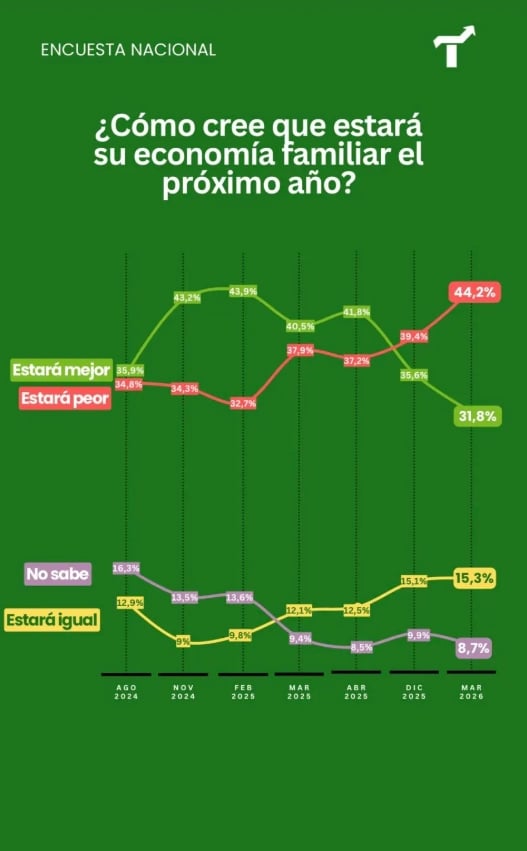
The deterioration of the presidential image does not occur in a vacuum; it coincides with a radical shift in perceptions regarding the economy and political responsibility. For the first time in months, expectation curves have crossed. A study by Tendencias indicates that a majority of respondents believe their family economy will worsen next year. Specifically, 44.2% of those surveyed expect their circumstances to decline, compared to 31.8% who think it will improve, 15.3% who predict no change, and 8.7% who are uncertain.
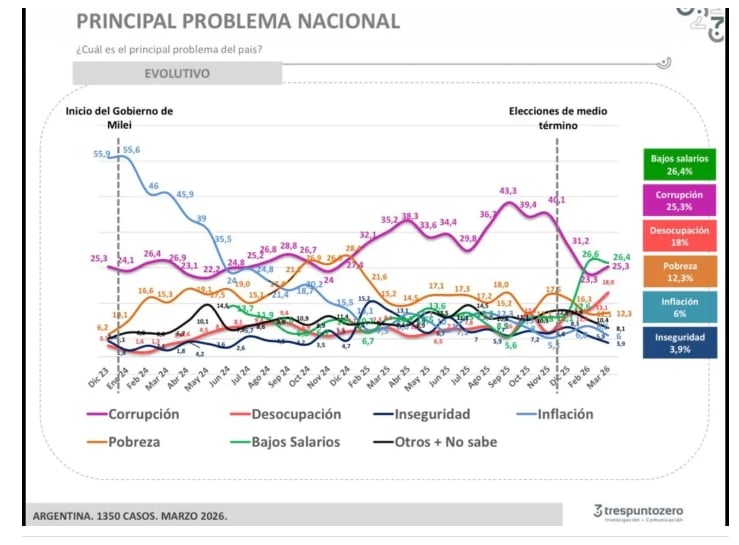
This decline in expectations is coupled with a shift in the agenda of concerns among Argentines. The Trespuntozero study revealed that, for the first time, low salaries rank as the top problem facing Argentina, leading the list at 26.4%. They are followed by high unemployment (18%) and poverty (12.3%), outlining a troubling picture of discontent focused on economic hardship.
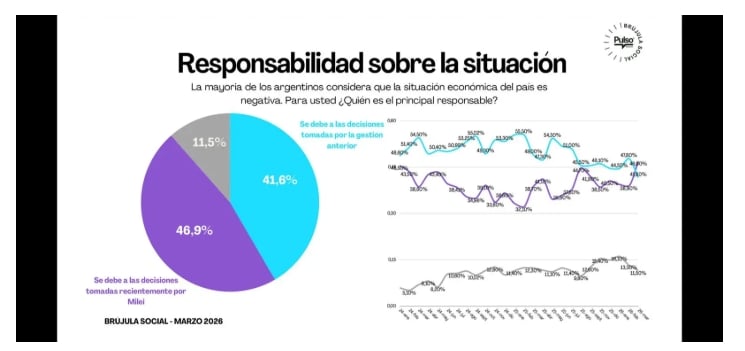
To comprehend the magnitude of the political crisis, it is essential to observe the reversal of a trend that had been maintained by the libertarian administration: the diminishing impact of the narrative surrounding the “cursed inheritance.” In March, consultancy Pulso, led by Juan Adaro, detected that traditionally, the majority of Argentines attributed the country’s current situation to Alberto Fernández’s government. However, for the first time, this tendency has flipped. When asked about the cause of the current situation, 46.9% of respondents identified Javier Milei’s government as responsible, while 41.6% blamed the previous administration.
In his article, El Destape suggested that amid this challenging scenario, questions regarding the president’s political future and his potential for recovery remain open. «Do the latest poll results signify a break in the president’s relationship with society? Is Milei’s core support among young men sufficient for a competitive run in 2027? Can he regain the trust of those sectors abandoning him? How could a defeat for Donald Trump in the midterm elections impact the government?»
For now, opinion studies reveal an ongoing popularity crisis for the libertarian leader, showing signs of deepening.
La entrada Cryptocurrency Scandal $LIBRA Impacts Javier Milei’s Approval Ratings: Rejection Approaches 60% se publicó primero en El Ciudadano.
🔥 Ver noticia completa en ElCiudadano.cl 🔥