El Ciudadano
Original article: Fraude electoral en Honduras: denuncian amenazas militares por “actas en cero”
A serious accusation regarding military threats directed at members of the Electoral Boards has raised alarms about the transparency and legality of the special counting process for the general elections held on November 30 in Honduras.
Political organizations and an electoral councilor have raised concerns over what they characterize as ongoing fraud, marred by coercion and foreign interference.
Members of the Liberty and Refoundation Party (Libre) and the Liberal Party presented testimonies and evidence detailing an alleged illegal intervention by the Armed Forces in the verification and recount process. Their constitutional duty, defined in Article 1 of the Armed Forces Constitutive Law, is to defend the principles of free suffrage and ensure security, not to intervene in technical decisions.
Thus, it is inappropriate for military personnel to coerce electoral board members or attempt to sway outcomes through threats, as their duty should protect them from such actions, while also ensuring the security of the process and materials involved.
However, in a video shared by Libre, it was reported that «all representatives of political parties on the special verification and recount boards were verbally assaulted by military personnel instructing them not to send any invalidated votes or documents with zero results; otherwise, they would be removed from the board and arrested immediately.»
This accusation coincides with a parallel situation. According to teleSUR correspondent Karim Duarte, approximately 200 members of the Liberal Party were threatened by the military officer in their counting centers, who informed them that they did not have the authority to submit zero-result documents—a legal right that boards do possess.
URGENTE | El @PLHonduras denuncia amenazas y coacción militar contra sus 200 representantes en el #CLE durante el escrutinio especial.
Señalan injerencia castrense (@FFAAHN) y sesgo político que pone en riesgo la transparencia electoral. @teleSURtv pic.twitter.com/hLpJUTwvJU
— Karim Duarte (@karimtelesurtv) December 21, 2025
For representatives of the Liberal Party, these actions highlight a political bias that interferes with electoral transparency.
What Are Zero Result Documents and Why Are They Legal?
The Special Verification and Recount Board holds the legal authority to send documents with zero results (indicating no votes assigned to any candidate) when significant and irreconcilable inconsistencies are detected. This might occur, for instance, when voting registers do not match the documents, signatures from board members are missing, basic data is contradictory, or when votes from that board are formally declared null and recorded in the incident report. It serves as a control tool to preserve the integrity of the vote, not as an infringement.
In response to the allegations, a member of an electoral board stated that «votes are defended by law, not by fear. Elections are guaranteed through transparency, not intimidation; democracy cannot be confined, silenced, or bullied; it must be respected.»
Electoral Councilor to Challenge Results
Amid the credibility crisis, National Electoral Council (CNE) councilor Marlon Ochoa announced he will proceed to contest the results, refusing to validate what he describes as a fraudulent process influenced by external interests, firmly standing by his commitment to uphold the Constitution, which states that the people’s will is sovereign.
«Not even if they take me to that plenary at gunpoint will they make me validate a fraud,» Ochoa declared, branding the elections of November 30 as «the dirtiest and least transparent» in Honduras’s history. He explained that the levels of manipulation and inconsistencies exceed even those noted during the controversial 2017 elections, which ended with the reelection of Juan Orlando Hernández amidst accusations of fraud and nationwide protests.
Recently, U.S. President Donald Trump granted clemency to Hernández, who had been sentenced to 45 years in prison for conspiracy to distribute over 400 tons of cocaine into the United States.
#OnceNoticias
| "Ni aunque me lleven a ese pleno a punta de bala me van a hacer validar un fraude": Marlon Ochoa
EN VIVO:
| https://t.co/8RfMAfnTed pic.twitter.com/o8CZADcIJI
— Canal 11 (@canal11hn) December 21, 2025

In light of the serious irregularities detected, Ochoa affirmed that «no circumstances compel him to sign a ‘fraudulent’ declaration,» referring to the official act of proclaiming results, which has a deadline of December 30.
He insisted that his duty is to represent the Honduran people, not foreign governments, and openly questioned the statements and sanctions from Washington as direct interference.
«The fraud has been visible to all, even if international observer missions want to hide or gloss over it,» he emphasized, as quoted by TeleSUR.
Demand for a Vote-by-Vote Recount
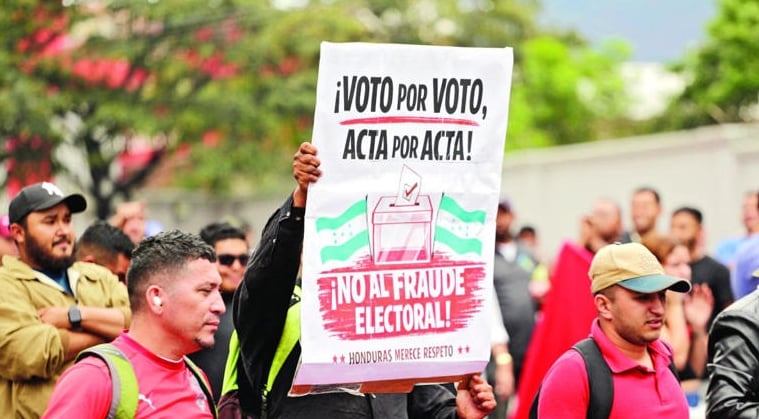
Councilor Ochoa has proposed the only solution that he believes can restore legitimacy to the process: a recount, vote by vote, box by box.
«My position is that to determine who won an election under the threat of foreign influence and gang activities, we must open all 19,167 voting reception centers,» he stressed, pointing to the evident discrepancies between the number of voters and the figures on the documents.
Additionally, he reported continuous and suspicious failures in the Preliminary Electoral Results Transmission System (TREP), which, he said, undermined transparency and created room for data manipulation. «If we conduct a vote-by-vote recount, I will gladly be part of the official declaration,» he concluded, establishing a clear line regarding his participation in any validation act.
The Honduran elections, which have yet to yield an official president for the upcoming term, remain in a state of high tension. Allegations of military threats to suppress zero-result documents, coupled with the outright challenge from an electoral councilor and accusations of foreign interference from Donald Trump, as well as organized crime, paint a picture of deep institutional crisis, leaving the country awaiting a resolution.
La entrada Electoral Fraud Allegations in Honduras: Military Threats Over «Zero Results» Documents se publicó primero en El Ciudadano.
🔥 Ver noticia completa en ElCiudadano.cl 🔥