El Ciudadano
Original article: Escritor Galo Ghigliotto vuelve a los cuentos con «Su cadáver avanza hacia el mar»: «Incluso una historia íntima o familiar puede ser profundamente política»
Galo Ghigliotto Returns to Short Stories with «His Corpse Moves Toward the Sea»: «Even an Intimate or Family Story Can Be Deeply Political»
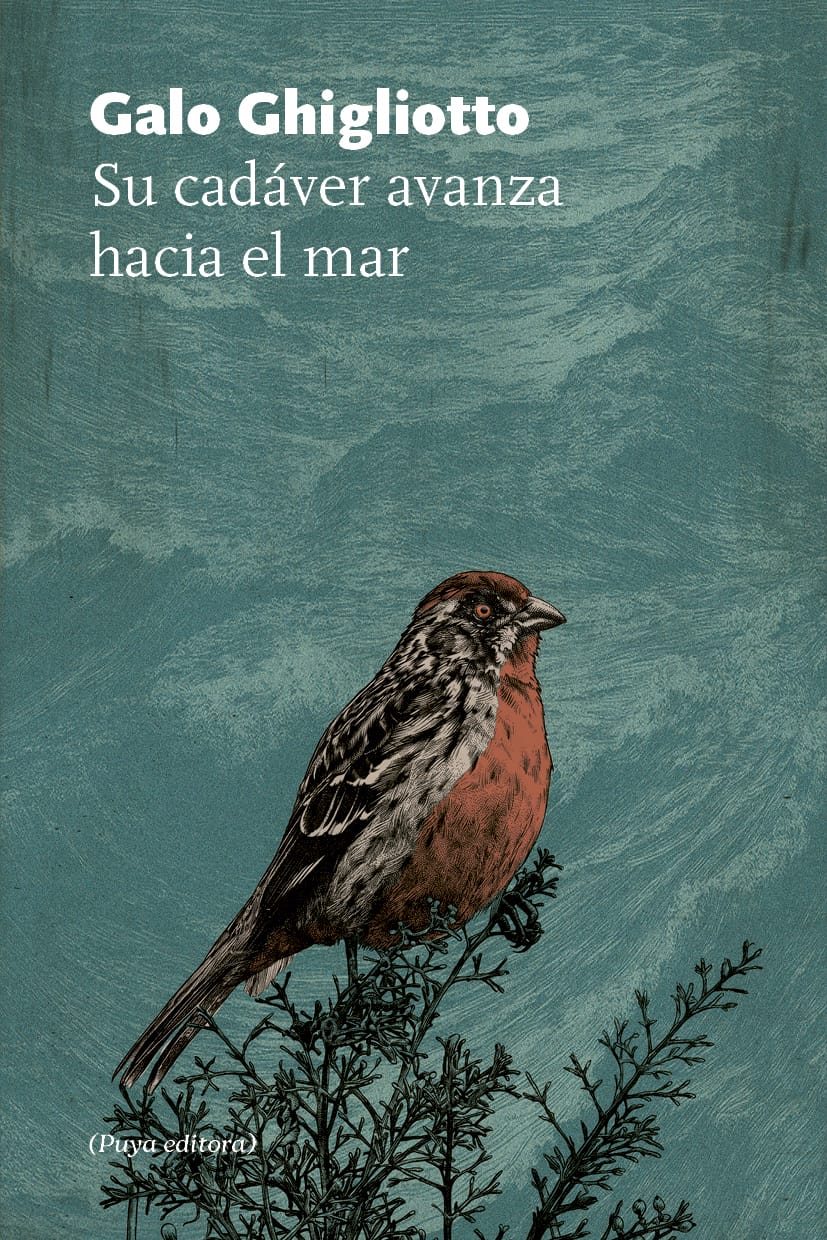
With the release of «His Corpse Moves Toward the Sea,» Galo Ghigliotto makes a comeback to short fiction after more than a decade, featuring eight stories that delve into themes of death, memory, and the various forms of violence present in everyday life.
Published by Puya Editora, the new imprint of Editorial Cuneta, this collection reaffirms central themes of Ghigliotto’s work, which has persistently explored the interplay between territory, grief, power, and language across poetry, narrative, and translation.
Galo Ghigliotto (Valdivia, 1977) is a writer, translator, editor, and cultural manager who has established a significant presence in contemporary Chilean literature.
As the author of poetry collections such as ‘Valdivia’, ‘Bonnie&Clyde’, ‘Aeropuerto’, and ‘Monosúper’; the short story volume ‘A cada rato el fin del mundo’; and novels including ‘Matar al Mandinga’, awarded the Municipal Prize at the Gabriela Mistral Literary Games, and ‘El museo de la bruma’, honored with the Best Literary Works Prize in 2020, Ghigliotto’s work consistently investigates themes of memory, territory, violence, and grief.
As a translator, he has introduced Spanish readers to authors like Annie Ernaux, Antonin Artaud, and Daniel Borzutzky. His role in promoting La Furia del Libro has made him a pivotal figure in the development of independent publishing and bibliodiversity in Chile.
In light of the publication of «His Corpse Moves Toward the Sea,» we spoke with Galo Ghigliotto about the connection between literature and politics, the themes that have marked his writing, the landscape of Chilean narrative, the role of independent publishers, and the challenges facing culture in our country today.
– Your stories are not pamphlet-like, yet they reveal power dynamics, violence, and inequality. Do you believe all literature is political, even when it does not intend to be?
I do, but not exclusively in an ideological sense. Literature can be political because it reflects forms of coexistence and allows us to judge even when there is no explicit ideology. It can be political not necessarily by discussing parties, governments, or slogans, but by illustrating how human relationships are organized: who holds power and how it is exercised, who can share their story and who cannot. Even an intimate or family story can be profoundly political.
However, I dislike writing from a purely ideological standpoint; it seems pretentious. When I began writing with a focus on political themes, it initially came out as pamphlet-like. Over time, I learned that the narrator does not have to declare everything; the characters should, and they should do so not only through their words but also through their actions.
There is a novel by Guebel called «El terrorista» where the protagonist is accused of blowing up government buildings, but even though he did not commit the acts, he decides to assume the blame to have something to say about his life. That novel left me pondering: is only the person who commits the acts a terrorist, or is it also the one who adopts the conviction? Or in another context: in Chile, were only those who took up arms, tortured, or executed directly the coup plotters, or were those who supported, justified, and benefited from that violence also involved?
– What discussions would you like this book to spark among its readers? Are there questions you hope remain open after reading?
I wouldn’t presume to dictate what conversations should emerge about the book, although I would certainly welcome them. Moreover, there are many types of readers, each with their own convictions about what the book should or should not be. Now that I’m in a position to respond, I think I can say that I don’t dwell on how the reader will perceive my writing; that thought can be intimidating.
I only aim to adhere to a piece of advice from Romain Gary, who suggested that a writer should be like a hotel bellboy, welcoming the guest, leading them to their room, and handing them the keys so they can enter on their own. I’m interested in that freedom: that the reader enters alone, observes what they want, feels discomfort where necessary, and grapples with their own questions.
Perhaps the most crucial aspect is not to overly guide the reading but to leave certain areas open for each person to determine what they judge, what they understand, what they find unforgivable, or what unexpectedly evokes a sense of compassion.
– Memory frequently appears in your stories. In a country where the dispute over memory remains a political issue, do you think literature has a particular responsibility in that debate?
Yes, but I dislike viewing narrative solely as an archive. I believe literary writing, even if autobiographical or testimonial, often transforms into fiction. I think literature must be more than a record left at a checkpoint or a testimony provided in a trial. It operates in more ambiguous realms, where the gaps also narrate.
In Chile, there are, of course, conflicting narratives about what happened: there are still sectors that deny, relativize, or justify the dictatorship, torture, persecution, and disappearance. But those narratives are not equivalent. I am not interested in presenting the horrors of the dictatorship as if it were a topic open to balancing opinions. There were crimes, victims, and perpetrators, along with a society that partly supported, justified, or chose to look away.
For that reason, I believe we must find ways to reactivate that memory, to refresh it, to ensure it reaches even those who think they already know it or those who have grown accustomed to hearing it as a closed narrative.
Sometimes, when a way of expressing becomes too fixed, it ceases to have an impact. Literature can seek alternative paths: approaching a side character, a minimal scene, a wound that appears displaced elsewhere—not to soften what occurred but to prevent it from becoming a formula that some hear without listening.
– Do you think this book marks the closure of a phase in your writing, or do you feel it opens a new path for future projects?
I believe it does both. On one hand, it collects stories written at different times, some quite far apart, and in that sense, it closes a long phase of work. However, I’m not sure that it extinguishes my interest in the themes it contains. I’ve been trying to put together a challenging book for a long time. Though it is based on a real character, someone I cared about deeply, that story is not free from the darkness we can see in these stories.
I also feel this book has heightened my awareness of certain forms that interest me: narratives that do not always resemble traditional storytelling, texts that might resemble a declaration, a report, an oral voice, a document, or a twisted confession. I am intrigued by the space where form does not merely accompany the story but also contaminates it.
– How do you view the current landscape of Chilean narrative? Are there themes, voices, or pursuits that particularly interest you in today’s literature? What topics are being addressed?
I see a highly diverse Chilean narrative, much broader than existed 20 years ago in terms of origins, registers, and modes of circulation. This means there is no longer a singular idea of «Chilean narrative.» There are many centers, many peripheries, and numerous ways of writing and reading. This is a healthy development.
I also believe there has been an interesting shift towards narrative forms that reclaim dialogue with a certain classical tradition, following nearly 20 years during which Chilean narrative was overwhelmingly characterized by autobiography or at times misunderstood autofiction. Patricia Espinosa aptly referred to the “selfie novel,” and I think that diagnosis illuminated quite well a segment of the literary output from those years.
It’s not that autobiography or autofiction is inherently problematic; there are extraordinary works in that vein. The issue arises when they become a formula, a constraint, a nearly obligatory means of legitimizing writing based on immediate personal experience.
Today, I see greater openness: narratives that return to imagination, world-building, plot, and characters that are not necessarily a transparent projection of the author. I am particularly interested in books that do not aim to appear universal by erasing their place of origin but instead, those that trust in the precision of a language, a territory, and a specific experience.
There are many names, so I wouldn’t want to reduce the panorama to a list, but I believe the works of Alejandra Costamagna and Lina Meruane are very powerful and coherent.
– You were one of the promoters of La Furia del Libro, a space that transformed the circulation of independent publishers in the country. Looking at that journey, what do you think it has meant for bibliodiversity in Chile?
I believe La Furia del Libro has been an important platform for the emergence, visibility, and growth of independent publishing in Chile. It may sound a bit pretentious to say it this way, but I think it’s true: when we started, the independent ecosystem was much more limited; there were about twenty publishers struggling to circulate, and today we speak of hundreds of projects with diverse catalogs, aesthetic lines, and political commitments.
Of course, this growth is not due solely to La Furia. That would be absurd to think. But I do believe the fair provided a space for meeting, circulation, and legitimization that enabled many publishers to reach new readers, connect with each other, and sustain themselves over time. As more publishers emerged, more opportunities opened for emerging authors, less visible writings, and content that likely would not have found a place within more traditional circuits.
In that sense, La Furia has contributed to bibliodiversity not only by gathering many books but also by facilitating more pathways for publishing, reading, and circulation. Bibliodiversity is not just a pretty word; it implies real conditions for a greater variety of voices, more catalogs, more editorial risks, and more opportunities for engagement between books and readers.
– La Furia del Libro began as an alternative to traditional circuits. Do you feel that spirit is still necessary, or has the publishing landscape changed significantly?
The landscape has changed dramatically, but that spirit remains essential. Today, there are more independent publishers, more fairs, more bookstores interested in small catalogs, and more readers attentive to other proposals. However, the structural issues persist: concentration, distribution difficulties, high costs, precariousness, limited territorial presence, and insufficient public policies.
An independent fair cannot remain frozen in nostalgia for its origin. It must constantly question what it means to be an alternative in a changing context. Sometimes being an alternative is not simply being outside the dominant circuit but creating new forms of relationships between publishers, readers, institutions, bookstores, and communities. The challenge is to maintain that critical energy while growing and becoming more visible.
– Do you believe there is a sufficient understanding in Chile of culture as a right rather than just a consumer good?
I think that idea is present in the discourse but not always in practice. Culture is often referred to as a right, but it frequently continues to be treated as an event, decoration, product, or management indicator. If culture were genuinely understood as a right, there would be a far more serious concern for access, public engagement, and the sustainability of those working in the sector.
Books, in particular, often get caught between two perspectives: either being seen as a commodity or treated as an almost sacred object. But they are also a tool for citizenship, imagination, memory, and critical thinking. For that to work, it is not enough to publish books; we must create conditions for readers to exist.
– How do you view the role of the State in relation to culture and books? Do you believe there is a consistent policy?
There have been significant advances, but it’s hard to speak of a truly consistent policy. Often, we rely on competitive funds, fragmented programs, or initiatives that change depending on authorities, budgets, or each administration’s emphasis. This creates instability and forces cultural agents to survive project by project.
A book policy should consider the entire chain: creation, editing, printing, distribution, bookstores, libraries, reading mediation, internationalization, and archiving. It should do so with a territorial perspective, not just from Santiago. The State has a crucial role, but that role cannot be limited to funding events or providing funds. It must build long-term cultural infrastructure.
– What role do independent publishers play today in shaping cultural debate? Is it possible to sustain an independent publishing project without taking a political stance regarding culture and the circulation of knowledge?
Independent publishers play a crucial role because they often publish works that do not find immediate space in a more concentrated market. This is where less obvious books, new authors, and projects that do not necessarily respond to immediate profitability logic appear.
I believe that sustaining an independent publishing project already implies a political position, even if it is not framed as militancy. Decisions about what to publish, how to circulate, pricing, who to work with, and how to engage with bookstores and readers—all of that expresses a vision of culture. Independence is not about purity or marginality; it is a way to contest meaning in an ecosystem where concentration tends to reduce diversity.
– If you were to envision the cultural landscape of Chile in the next ten years, what concerns you, and what gives you hope?
I am concerned about the precarization of cultural work, the concentration of circulation, the weakening of reading, and the potential for culture to become increasingly subordinated to immediate visibility logics. I also worry that social media has imposed a velocity that often contradicts the lengthy, quiet, and complex processes books require.
However, I also find hope in the many people who continue to create, edit, read, organize fairs, open bookstores, initiate projects in regions, translate, conduct workshops, and build communities. There is a very persistent energy within Chilean cultural circles, even under difficult conditions.
Chilean culture has often survived thanks to that mix of stubbornness and enthusiasm. I hope in the coming years, it will have better conditions.
La entrada Galo Ghigliotto Returns to Short Stories with «His Corpse Moves Toward the Sea»: «Even an Intimate or Family Story Can Be Deeply Political» se publicó primero en El Ciudadano.
🔥 Ver noticia completa en ElCiudadano.cl 🔥