El Ciudadano
Original article: Cúpula Dorada: El nuevo juguete bélico estadounidense
By Pablo Jofré Leal, Journalist and International Analyst
The U.S. military-industrial complex is an ever-hungry beast, perpetually seeking more. With an insatiable appetite, especially under the second administration of Donald Trump, there is a clear intent to militarize outer space, aiming for total hegemonic control over the globe.
This involves the creation of a missile defense shield that, while appearing uncertain in its success, also undermines the fragile state of global security (1).
The public-private military industry stands as a critical economic pillar of American society and its government administrations, whether democratic or republican. They require this complex as an essential resource to catalyze their economy and sustain a policy of hegemony, generating global insecurity, destabilization processes, collective fears across five continents, and aggressive wars that necessitate increasingly expensive and destructive weaponry.
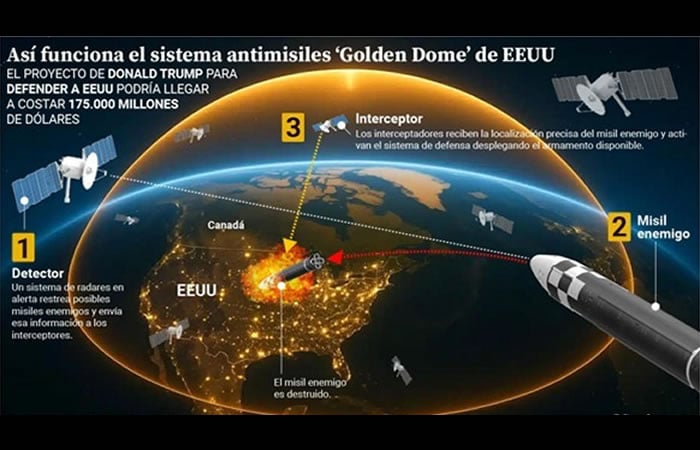
With this context in mind, the Trump administration is developing a layered ballistic missile defense system called the «Golden Dome» as part of its national security strategy unveiled by the end of 2025 (2). This name reflects the exorbitant taste of the occupant of the White House.
The layered approach defines a multi-level system based on interceptor weapons designed to take down enemy missiles, primarily ballistic and cruise missiles. Currently, there is no efficient containment system for hypersonic missiles in the possession of Russia, North Korea, and Iran, which remains one of the critical limitations of this military project as of 2026.
This initiative clearly aims to resurrect what was known as the Strategic Defense Initiative (SDI), initiated by former President Ronald Reagan. The goal of SDI—popularly known as Star Wars—was to create a space and ground shield using laser technology to destroy nuclear missiles from the former Soviet Union before they could reach U.S. soil, making mutually assured destruction obsolete.
This project faced criticism from its inception, with $30 billion invested between 1983 and 1989, equivalent to $97.967 billion today, considering an estimated inflation of over 226% during that period.
High costs, technological infeasibility, and increasing arms tensions with the former Soviet Union were among the criticisms then. Today, U.S. Democratic congress members label this project as «prohibitively expensive, operationally ineffective, enormously corrupt, and detrimental to the security of the United States and the world» (3).
Like SDI, Trump’s «Golden Dome» is estimated to cost around $200 billion, with fears it will trigger an unprecedented arms race.
Trump has stated he expects the shield to be operational by 2029; however, various analysts, including the Congressional Budget Office, indicate that the total cost could reach $600 billion over the next two decades—far from original budgetary projections.
This funding will not only deplete U.S. tax coffers but will also place significant pressure on NATO allies, who will need to contribute large sums to raise military spending from 2% to 5% of GDP by 2035.
This means an additional €510 billion per year to achieve the 5% GDP target for military expenditures (4), leading to severe cuts in social spending.
Let’s consider additional pressures, such as territorial concessions. This refers to Trump’s policy of forcing Denmark to cede Greenland, regarded as a strategic node for the Golden Dome missile shield project, which proposes utilizing the geographically critical island between North America, Europe, and Asia as a potential missile trajectory route, allegedly from Russia and even from China, towards the United States.
This attempt to establish a missile dome while demanding territorial concessions undoubtedly reflects U.S. ambitions to intervene in northern Russia’s maritime routes, particularly in Arctic geopolitics. The U.S. seeks to gain control over Greenland, a Danish territory envisioned to host strategic systems like early-warning radars, missile tracking equipment, and new satellite and space infrastructure.
The clear imbalance of power that the Golden Dome would create will provoke responses from countries such as Russia and China, aiming to counter this offensive initiative. It requires an extensive network of reconnaissance and combat action satellites to accurately track enemy missile launches in real time and neutralize them using advanced weapon types such as lasers, kinetic weapons, or orbital radiofrequency systems.
In 2025, Russia and China issued a joint statement condemning the U.S. effort to utilize outer space, accusing it of aiming to transform it into an unsafe environment and a battleground. Both nations, during the 80th anniversary of victory in World War II and the establishment of the United Nations, emphasized the «critical importance of maintaining and strengthening global strategic stability.»
The aforementioned statement, detailed (5) for its relevance, asserted that «the recently announced ‘Golden Dome’ program is deeply destabilizing. It is a large-scale initiative designed to establish a global, multi-layered missile defense system without restrictions capable of protecting against any missile threat, including those from adversaries with similar capabilities.»
The implication here is an absolute rejection of the inseparable interrelation between offensive and defensive strategic weapons, a fundamental principle for maintaining global strategic stability. The project also enhances the development of both kinetic and non-kinetic means to neutralize missiles before their launch, alongside the necessary supporting infrastructure.
The situation is exacerbated further by the fact that the «Golden Dome» program also directly foresees a significant strengthening of arming capabilities for combat operations in space, including the development and orbital deployment of interception systems, transforming outer space into a zone for weapon placement and armed confrontation.
Both Russia and China oppose attempts by some nations to militarize outer space and announced they would counter security policies and activities designed to achieve military superiority using outer space as a «theater of war.»
In effect, this goal aims at dismantling the fragile structure of existing security to further benefit declining U.S. hegemony through its allies.
Within the U.S. military and political establishment, there have been criticisms regarding the execution of this billion-dollar military plan. However, there is a general consensus that the «Golden Dome» primarily seeks to pressure Russia and China in necessary negotiations about arms limitation.
In contrast to the U.S., which persists in its hegemonic and arrogant policies, Russia and China have proposed numerous opportunities to mitigate and even halt the arms escalation in the interest of global security.
As early as 2008, during the Geneva Disarmament Conference held on March 31 and April 1, both powers proposed an international treaty to prevent an arms race and the militarization of outer space. The proposals included a ban on the placement of any type of weapon in Earth’s orbit and the destruction of space objects.
This historic meeting subsequently led to the delivery of a comprehensive report from the conference, organized by the United Nations Institute for Disarmament Research (UNIDIR), titled «Security in Space: The Next Generation,» which I invite readers to review for its historical significance (6).
The UN General Assembly, despite its weaknesses, remains the principal forum for world nations to meet. It is a point for discussion and evaluation of resolutions stemming from Disarmament Conferences, where countries have largely voted in favor and share the vision and efforts of Russia and China in this regard. Conversely, the U.S. and its closest allies chronically vote against in a negligent and irresponsible manner.
Analysts like Brian Tierney, a former Pentagon official now at the Center for Arms Control and Proliferation, characterize the «Golden Dome» as «essentially a scam» destined to waste billions on something that won’t work, as enemy missiles are significantly cheaper to produce than the necessary interceptors.
In turn, Laura Grego from the Union of Concerned Scientists deems the initiative a «bad idea, costly, and vulnerable,» suggesting it would require tens of thousands of satellites which could overwhelm with mass missile attacks.
The expert in nuclear weapons and astrophysics suspects the interest lies in the fact that «there’s a lot of money to be made» for involved parties, including well-known contractors like Lockheed Martin or SpaceX and emerging companies from Silicon Valley like Anduril or Palantir (6) eager to grab a piece of the hundreds of billions in this monumental military project.
The space around Earth is already saturated with satellites. As of December 2025, an estimated 11,700 active satellites orbit the planet, according to astronomer Jonathan McDowell from the Harvard & Smithsonian Center for Astrophysics. Most are in low Earth orbit (under 2,000 km), led by SpaceX’s Starlink mega-constellation owned by trillionaire Elon Musk, accounting for 60% of the total satellites; it is estimated that 35% of these devices are military assets.
Undoubtedly, the Golden Dome concept is riddled with contradictions and complexities, as it involves intercepting missiles at various flight phases using an array of advanced technologies: sensors, long-range radars, interceptor missiles like Arrow and THAAD, which are used by the Israeli Zionist regime in the so-called Iron Dome and David’s Sling, which have shown structural shortcomings in their aggressive war against Iran.
Increasingly, U.S. political dynamics, international analyses, and media coverage overwhelmingly suggest that Donald Trump’s grandiose initiative to establish a Star Wars-style system for 2026 is merely a flashy distraction intended to bolster the image of an increasingly megalomaniacal leader.
A leader who is dismantling the few existing international security structures, wielded as an instrument of pressure against perceived geopolitical rivals, and whose obsession with realizing «unattainable dreams» risks endangering the world. This lavish project represents an additional financial burden, not just for the already monumental U.S. war budget but also for its NATO partners.
In this context, the call to the so-called international community and the societies of the world is to support the initiatives of China and Russia to prevent any form of armament in orbits close to the planet, thereby enhancing international security.
It is unacceptable to fulfill the purely media-driven ambitions of Donald Trump, which have been criticized throughout.
Pablo Jofré Leal – Article for HispanTV
NOTES
- https://www.chathamhouse.org
- https://www.hispantv.com/noticias
- https://www.elmundo.es
- https://legrandcontinent.eu
- https://www.fmprc.gov.cn.
- https://documents.un.org/doc
- https://www.cooperativa.cl/noticias
The Citizen
La entrada Golden Dome: The Controversial New U.S. Military Initiative se publicó primero en El Ciudadano.
🔥 Ver noticia completa en ElCiudadano.cl 🔥