El Ciudadano
Original article: “Trump es Hitler”: gobierno denuncia presunto hackeo tras mensaje publicado en cuenta de Kast
Government Claims Hack After Inflammatory Post Links Trump to Hitler on Kast’s Account
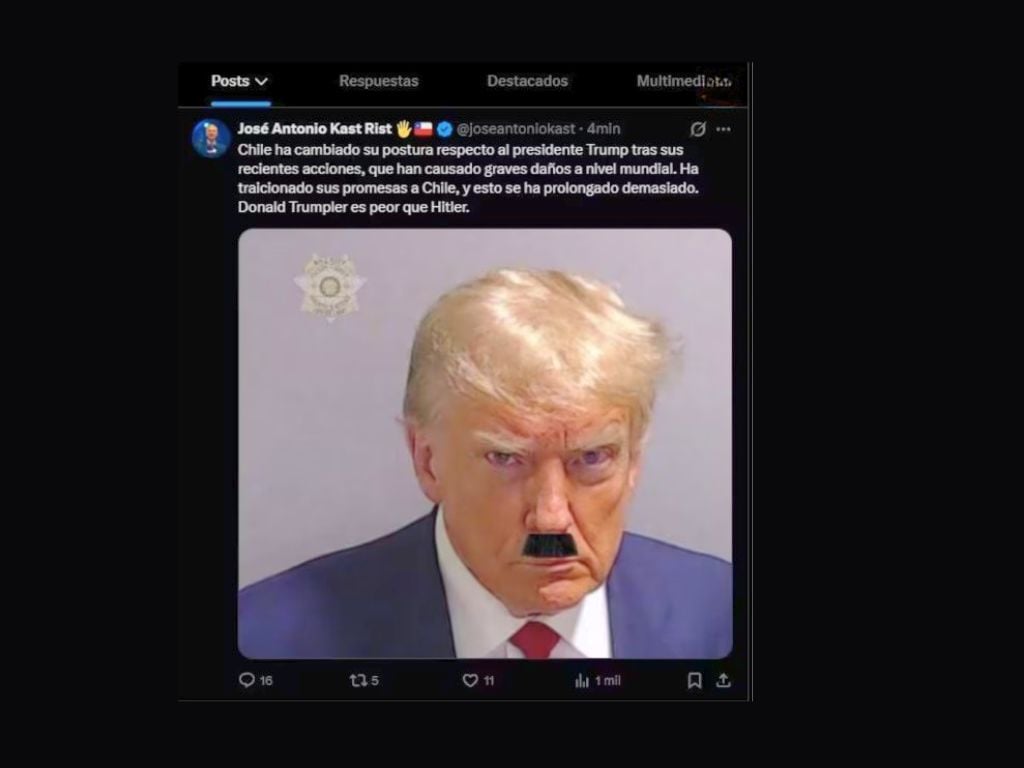
An explosive and unusual message emerged early Thursday from the personal account of José Kast, providing a new challenge for the Chilean government. The post criticized Donald Trump, comparing him to Hitler. Although the tweet was deleted shortly after, it circulated widely before La Moneda took steps to distance themselves from the statement.
«Chile has changed its stance on President Trump following his recent actions, which have caused significant global damage. He has betrayed his promises to Chile, and this has gone on for too long. Donald Trump is worse than Hitler,» the post stated.
The official reaction was swift: the government reported that the President’s accounts on X (formerly Twitter) and Instagram had been «compromised by third parties.» In other words, the government suggested a possible hacking incident. However, beyond this narrative, the episode raises a crucial question in digital politics: was this truly an external breach, or an internal post that was later retracted?
A Message That Triggered Alarm
The post attributed to Kast’s account did not go unnoticed. Not only because of the tone, but also due to the target of the attack: Donald Trump, a figure with whom the Chilean President has been politically and ideologically linked on various occasions for being far-right.
This detail makes the episode even more sensitive. It was not just any message or an ambiguous phrase. It was a politically charged post, issued from an account directly associated with the head of state, capable of generating immediate effects on the media and diplomatic agenda.
Therefore, the government quickly opted to set a narrative: that the accounts had been compromised and that the viralized messages did not correspond to Kast.
The Official Thesis: A Presumed Hack
According to the Executive, the alarm was triggered after detecting irregular activity on the President’s personal social media accounts. La Moneda also warned that new content contrary to the President’s will could appear, urging the public not to attribute any future posts to José Kast.
At this point, the official thesis is set: there was an external breach. However, the use of the term presumed hack is no minor detail. It marks a distinction between a political or communicational complaint and a technically established conclusion.
This distinction is significant. Because, at least with the information available, there is no public evidence to completely clarify whether the message was the result of an external intervention or if it could have been issued by someone with access to the account and later removed.
The Issue of Presidential Social Media
In the age of instant communication, a presidential post carries a political weight that far exceeds that of any other account. It is not just a message: it can move markets, alter diplomatic relations, ignite media crises or trigger political conflicts within minutes.
This makes the current episode particularly delicate. The issue lies not only in the content of the message against Trump but also in the fragility that exposes the presidential communication system. If it was hacking, then security vulnerabilities are severe. If it was not, the problem shifts to: a massive internal error or disorder.
In either case, the situation is serious.
More than a Digital Incident
What occurred cannot be reduced to a mere anecdote on social media. The episode touches on a deeper area: the credibility of presidential communication.
Because once a message appears on a President’s account (remember the case of Javier Milei and the cryptocurrency), its circulation no longer depends on its continued publication. A screenshot, a repost, or rapid viralization can ensure that the damage is done. Deleting it later does not neutralize the effect. It merely attempts to contain it.
And there lies another key point: the government’s reaction was more defensive than explanatory. A thesis was established, presumed hacking, but without additional public elements to support it in that initial moment. This leaves an inevitable margin of uncertainty.
The Political Doubt Left Open
In these cases, the speed of the official disavowal often responds to an obvious need for damage control. But it also creates a tension: the more sensitive the content published, the more important it becomes to clarify its origin precisely.
In this instance, the government’s narrative seeks to quickly close the episode under the guise of an external intervention. However, the very nature of the incident forces consideration that not every uncomfortable publication on an official or presidential account can be automatically explained by hacking. There is also the possibility of internal access, human error, or posts made by collaborators with control of the account.
This gray area is what makes the episode politically relevant.
A Problem That Doesn’t Vanish with a Click
The message was deleted, but the problem did not disappear with the removal. On the contrary, a new focus of fragility in the President’s communication environment has emerged, adding to other recent episodes where La Moneda has come under scrutiny for how it tries to manage and control its public narrative.
If there was a hack, the government faces a severe digital security failure. If not, the crisis is of a different nature: political control, internal responsibility, and public credibility. In either scenario, the episode again highlights a flank that was already open due to the failed establishment of the narrative around a supposed “Bankrupt State» to explain the fuel crisis.
For now, La Moneda leans towards the first thesis. But until further information emerges, the only clear takeaway is that a single post was enough to spark a highly impactful controversy, put the government on the defensive, and once again reveal that, in the digital era, the true problem is not always just what is published, but also what is attempted to be explained afterward.
La entrada Government Claims Hack After Inflammatory Post Links Trump to Hitler on Kast’s Account se publicó primero en El Ciudadano.
🔥 Ver noticia completa en ElCiudadano.cl 🔥