
El Ciudadano
Original article: Investigadora especialista en migración y fronteras analiza el fondo del desalojo del Cerro Chuño en Arica
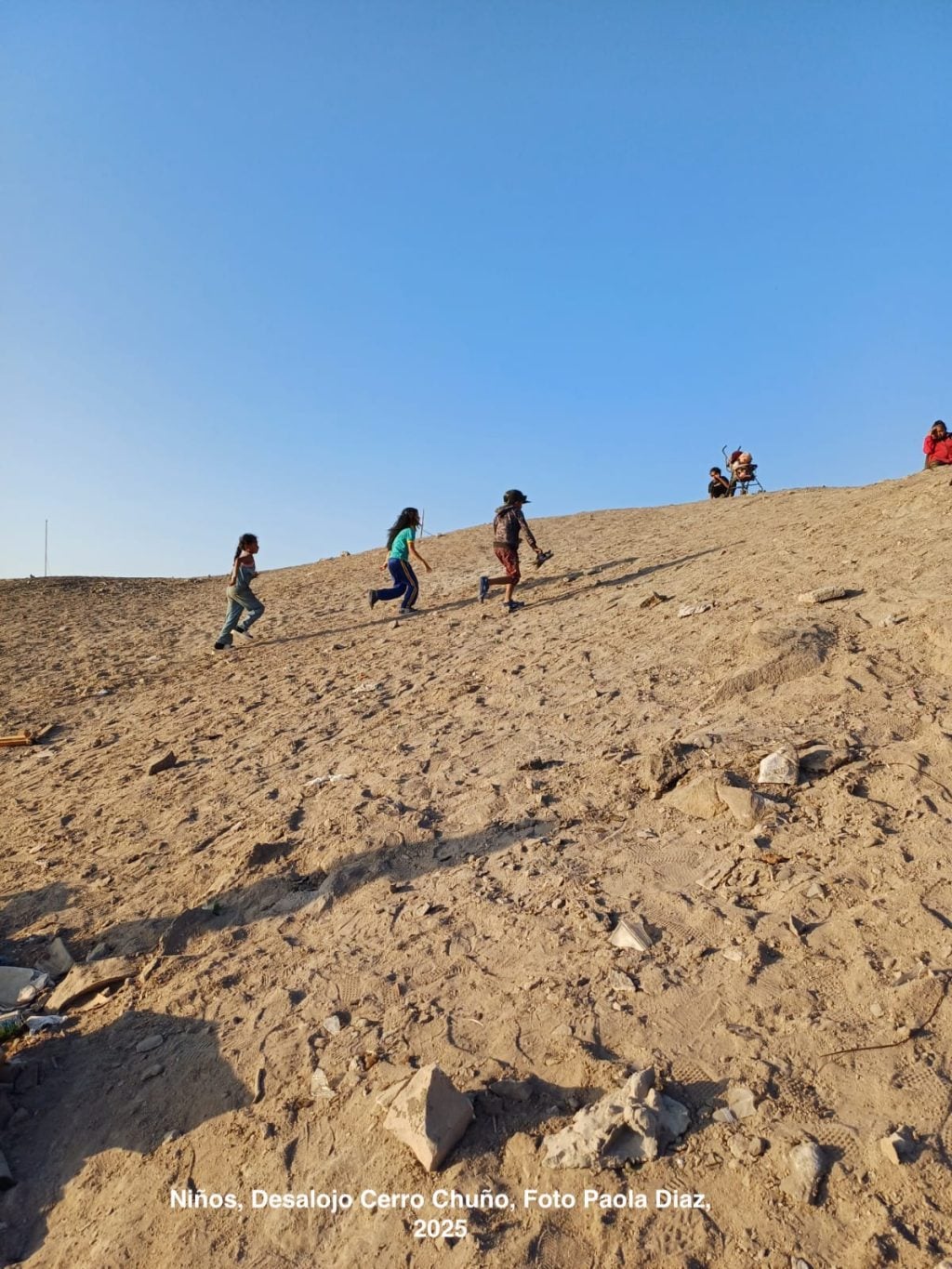
This is not the first eviction at Cerro Chuño in the city of Arica. Paola Díaz, an academic and researcher at the University of Tarapacá, has witnessed events occurring in November 2024, May 2025, and July 2026.
«Unfortunately, this territory and its people have been stigmatized,» noted the anthropologist and sociologist, who has worked for 20 years in countries like Mexico, the United States, France, and Italy, and since 2023 in Arica and Parinacota, studying international migration and violence at borders and urban areas arising from land occupations.
The researcher emphasized, «The focus is placed on spectacularizing the situation, leading to the stigmatization of the territory, its people, and the communities,» without adequately addressing the underlying issues. This area is known not only for environmental contamination and toxicity but also for the significant presence of migrants and the existence of criminal gangs.
Regarding organized crime, the researcher clarified that «it goes far beyond mere land occupation. We have significant projects in Chile addressing complex criminality, like the one with academic Romina Ramos (Social Work-Uta-Iquique), which indicates that we are targeting small fish instead of the larger players.»
In this sense, she added, «There is historical evidence, for instance, in Mexico, where I have worked and continue researching narcopolitics and necropolitics, indicating that combating organized crime through the stigmatization of certain people and communities is not effective, nor is targeting small fish.»
Drawing from her research experience, the academic states that «a more effective approach would be preventive, focusing on preventing child recruitment and ensuring state presence in areas like Cerro Chuño, starting from 2024 when we began our ethnographic work visiting weekly.»
She detailed other effective measures, «such as those implemented in Italy, which involve intervening in financial flows, money laundering, and targeting major financial crimes where legal and illegal funds intermingle.»
The academic highlighted that «one could argue that there is a Tren de Aragua presence in Chile, along with franchises of Tren de Aragua and other transnational gangs, but neither the Venezuelan community nor any other community is involved in these criminal networks.»
In fact, she noted, «There are reports from the Public Prosecutor’s Office indicating that the first victims of these networks are often the people closest in proximity or the most vulnerable individuals, who are the poor, irregular migrants, and people in various situations of disadvantage and social inequality.»
Migrant Families
Another focus, according to the anthropologist and sociologist, is that the narrative from some media emphasizes «irregular immigration, often labeling individuals as ‘illegal’ in public discourse. In critical studies of migration and borders, many of us in Chile, Latin America, and other research areas have discussed illegalization and irregularization, following De Génova’s idea of how certain individuals are legally illegalized through the law, requiring documentation and procedures to which they have no access.»
This occurred, she recounts, «with working-class families.»
«For instance, in the Venezuelan context of 2017, when these individuals fled hunger and lack of medical services in their country. In their desperation to escape, without means to pay for a passport or the bribes needed for the process, meeting the requirements for the visas requested in Chile since 2018 became incredibly difficult. Thus, there is a legal process that results in the irregularization of certain people, making them much cheaper labor than nationals,» the expert clarified.
Díaz explains that «this does not only happen in Europe and the United States; it has historically occurred in Chile with the Peruvian, Bolivian, Dominican, Haitian populations, later the Colombian, and for several years now the Venezuelan population.»
A third narrative focus is portraying territories like Cerro Chuño as filthy places.
Cerro Chuño is a contaminated area where residents have developed chronic, severe, and fatal illnesses, «yet there is sensationalism from both the media and some authorities associating the occupations and the people living there with rubbish, waste, and dirt,» warns the academic.
Therefore, she added, «to associate certain territories with garbage and that garbage with people seems stigmatizing when the structural problem is inequality, both urban and social. It reflects a process of human and material disposability. Hence, it’s not surprising that certain impoverished populations are stigmatized as dirty, illegal, and criminal.»
We will continue to report.
La entrada Migration Expert Analyzes the Underlying Issues of Eviction at Cerro Chuño in Arica se publicó primero en El Ciudadano.
🔥 Ver noticia completa en ElCiudadano.cl 🔥