El Ciudadano
Original article: Milei sintió el remezón: sindicatos desbordan plazas y el Gobierno patea la reforma laboral para febrero
Argentina’s President Javier Milei was compelled to make a politically significant tactical retreat on Thursday. The Senate, unable to secure the necessary votes amid a powerful union demonstration, agreed to postpone the contentious labor reform debate until February 10, 2026. This decision unexpectedly halts the government’s strategy for an expedited review of its flagship deregulation initiatives during the extraordinary sessions.
The official announcement was made during a joint session of the Senate’s Labor and Budget Committee, led by ruling party senator Patricia Bullrich. «We will sign a report to leave it open for modifications and suggest moving the debate to February 10,» the legislator stated, justifying the extension in light of the numerous observations received from various sectors.
The agreed-upon formula involves signing an «open» report in the coming days, which will keep the text active for amendments throughout January, aiming to attain broader consensus before the parliamentary discussion.
For the opposition, this postponement signals clear government weakness and miscalculations. «As they have been doing, they attempted an expedited treatment of all laws and today had to backtrack because they lacked the necessary support,» remarked Carlos Linares, a senator from Unión por la Patria.
In an interview with radio station La 750, he characterized the maneuver as a recurrent pattern: «This is a government that listens little, that does not understand that this is dialogue, this is consensus,» he emphasized.
| Massive mobilization in #PlazaDeMayo, #Argentina, against the unpopular #ReformaLaboral.
Thousands of workers and popular organizations defend their rights against the austerity policies of Javier Milei’s administration. pic.twitter.com/BB18mCQS5M
— teleSUR TV (@teleSURtv) December 18, 2025
Unions Flood Streets Against Milei’s Labor Reform
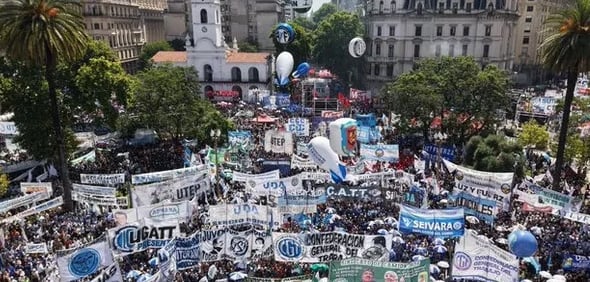
The parliamentary decision cannot be separated from the scene witnessed in the streets. Hours earlier, thousands of workers packed Plaza de Mayo and Avenida de Mayo in a demonstration organized by the General Confederation of Labor (CGT). The protest, which saw participation from the entire labor movement, opposition legislators, and Buenos Aires Governor Axel Kicillof, showcased the new leadership unity of the labor central.
Discourse from the stage—set up facing away from the Casa Rosada—was a series of stern warnings and critiques of the economic model. The CGT’s General Secretary, Jorge Sola, labeled the reform as «an attack on the freedom this government claims to defend, the only asset a human being possesses, which is work.»
During his speech, Sola linked the initiative to historical projects aimed at labor precarization: «They want to create a severance fund so that firing becomes free,» and warned that this fund would be fed by «the money from retiree contributions.»
He also called out one of the key terms in the libertarian discourse: Freedom. He argued that the Milei administration abuses this term, stating that «there is no freedom without social justice, no matter how anyone feels about it.»
In light of this abuse, the triumvirate emphasized the need to reclaim and rebuild what the libertarians claim to detest: social justice.
“Let us not forget that we must build socially and politically to confront this government. We must feel, we must listen, we must be humble. We must reignite the passion for the banner of social justice, we must reignite (…) every battle we fight is a victory, which is why we must mobilize across the country; social justice exists and has made us better,” he stated in remarks reported by Página/12.
Moreover, he warned that the so-called «libertarian» government aims to break the social contract because «they no longer care about including workers in the dialogue. But there is no freedom without social justice.»
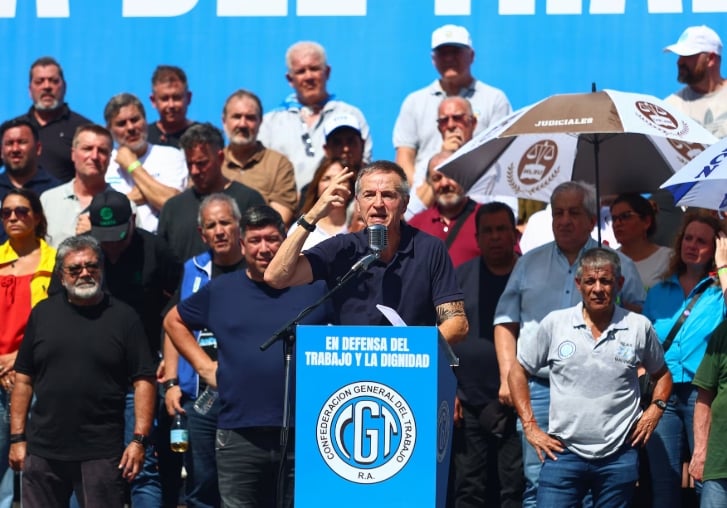
The confrontational tone remained consistent. Octavio Argüello, another of the CGT leaders, issued a direct warning: “Watch what you do because the people and the homeland must be defended. If you do not listen to us, we will go for a national strike.”
“We come to say a resounding no to any labor reform that betrays our interests. Let us not be deceived anymore,” he declared, eliciting applause from the crowd.
Cristian Jerónimo, the third member of the CGT triumvirate, criticized the core of the government’s discourse: “This project is written and maliciously drafted in favor of big corporations and the large companies of Argentina.” He added, “Where is the promised influx of dollars? People are suffering; we tell the President this. This economic model has already failed.”
Axel Kicillof, speaking from the plaza, amplified the opposition: “This labor reform does not contain a single element that benefits workers.”
Argentine workers are massively protesting against Milei’s labor reform
The historic Plaza de Mayo witnessed once again the strength and dignity of Argentina’s working class. Just an hour ago, thousands of workers took to the streets of Buenos Aires… pic.twitter.com/hq351xzHzt
— teleSUR TV (@teleSURtv) December 18, 2025
Official Strategy: Attempting to Rectify to Avoid Failure
Faced with this dual pressure—in the streets and in the Senate corridors—the government opted to defuse the legislative time bomb. The partial defeat suffered days earlier in the Chamber of Deputies during the 2026 budget debate, where key allies rejected articles concerning disability and university funding, served as a «harsh warning» that, according to opposition assessments, the government was slow to interpret.
The 45-day postponement grants the ruling party leeway to attempt to dismantle the resistance, technically adjust the text, and seek the support that currently eludes them. Labor Secretary Julio Cordero tried in recent hours to ease tensions by clarifying that changes would only apply to new hires, ensuring the rights of workers already employed. An argument that failed to calm the waters.
However, the opposition warns of an alternative strategy. Carlos Linares denounced that the executive plans to vote on the 2026 budget on December 26, a maneuver he believes is coordinated. He also cautioned about the risk of a presidential veto following the budget law to manage allocations with discretion. «They feel very comfortable redirecting funds, which have been pending for two years,» he remarked, as cited by TeleSUR.
Labor Victory and a Deferred Battle
As Thursday evening fell, while the labor columns dispersed to the rhythm of the Peronist march, the atmosphere among the opposition felt one of temporary triumph; however, the truce remains fragile. The project was not shelved, only paused. Milei’s government bought time to regroup its persuasion strategy and lobby efforts. Meanwhile, the unions solidified their unity and displayed strength, leaving a concrete threat on the table: the escalation of their struggle plan and a national strike.
The final words from Jorge Sola on stage resonate as an echo of a pulse that is far from finished: «Continue ignoring us and you will encounter the deepening of this struggle plan. We will finish with a national strike.» February 10 looms on the horizon as the next date for a battle that, today, the overflow of public pressure managed to postpone.
La entrada Milei Faces Backlash as Unions Flood Streets, Labor Reform Debate Pushed to February se publicó primero en El Ciudadano.
🔥 Ver noticia completa en ElCiudadano.cl 🔥