El Ciudadano
Original article: Nicole Rocha: la científica de la UACh que convirtió la ciencia comunitaria en evidencia científica
We interviewed one of the grant recipients from the Women’s Leadership Thesis Support Fund, who recently defended her master’s thesis focused on intercultural community monitoring of water in the Ranco Lake sub-basin. In this discussion, she shares her experience researching alongside Mapuche communities and reflects on the role of women in science.
When Nicole Rocha defended her master’s thesis, she not only concluded several years of academic pursuit but also wrapped up a research project built with the Mapuche Williche collective, Epu Lafken Mapu. Here, scientific knowledge dialogues with local insights to safeguard the waters of Lake Ranco.
Titled “Evaluation of Water Quality in the Sub-Basin Affluent to Lake Ranco through Mapuche Huilliche Community Monitoring (2023-2025),” her research aimed to address a crucial question: What impact do fish farms have on water quality in the oligotrophic systems of this region?
To explore this, she analyzed water quality at 11 points in the sub-basin, utilizing data gathered by the Epu Lafken Mapu collective through community monitoring. She compared this data against environmental criteria and evaluated the condition of rivers by observing organisms such as aquatic insects and fish. Results indicated that in areas downstream of the fish farms, there were higher concentrations of nutrients like phosphate and nitrate. Furthermore, these locations exhibited a more degraded ecosystem, with less fish diversity and increased presence of invasive species, such as rainbow trout.
Nicole visualized this information through maps, enhancing the understanding of river conditions and supporting decision-making within the territory.
In 2025, her work earned recognition by securing the Women’s Leadership Thesis Support Fund from the Science 2030 Sub-Antarctic Consortium. More than just a financial support to complete her master’s, this acknowledgment emphasized the value of research committed to community engagement and collaborative knowledge construction with Mapuche communities. Additionally, it proposes a methodology that other indigenous communities can adapt to aid in territorial conservation and promote well-being.
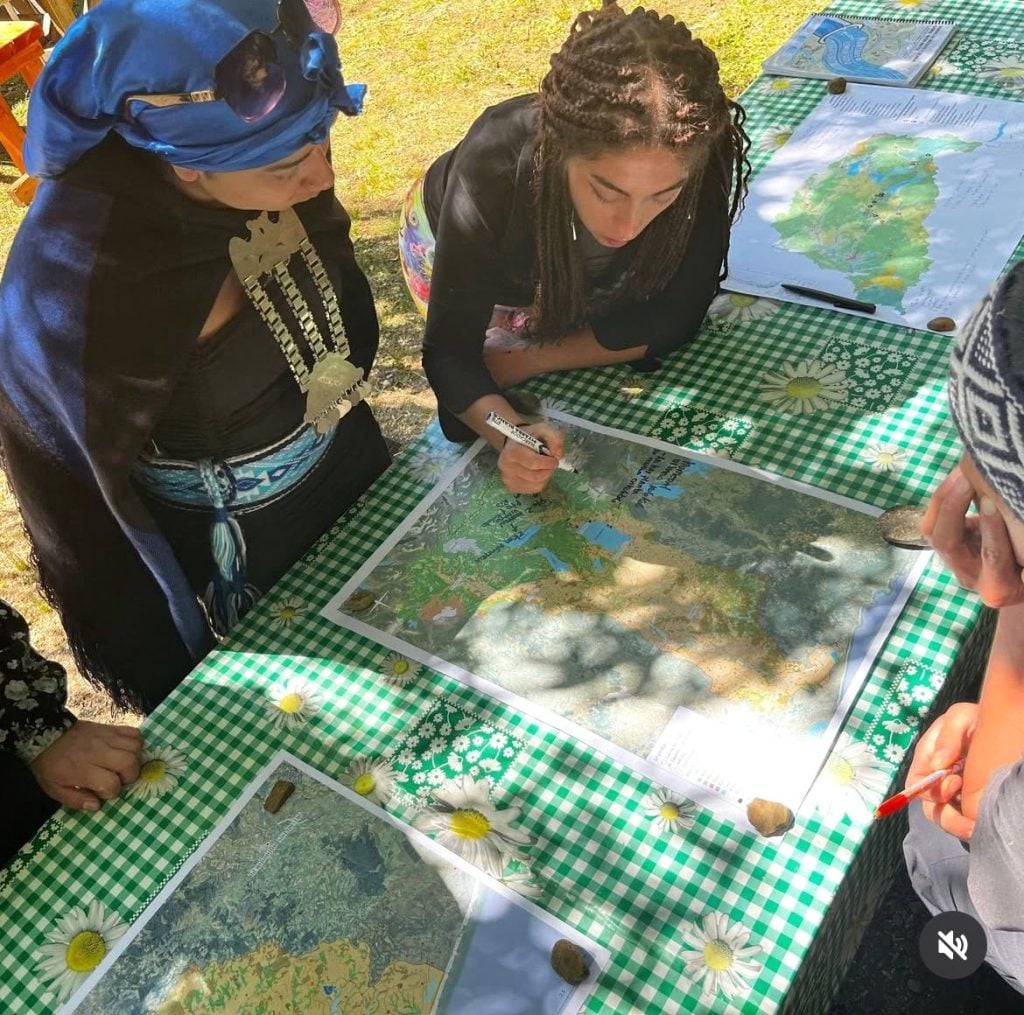
«It was a highly valuable acknowledgment of my research and the work done in support of the collective. I deeply appreciate that spaces exist to support female researchers and studies with a community focus,» she reminisces.
However, her journey in science began long before her thesis.
Before embarking on her research in the Water Resources Master’s program at the Austral University of Chile (UACh), Nicole Rocha was already seeking ways to integrate different facets of her life. Her background as a geographer, coupled with environmental activism, interest in politics, and a deepening connection to Mapuche language and culture, shaped a distinctive understanding of ecosystems.
Over several years, she participated in courses on Mapuche language and culture led by her lamgen (also written as lamien, a term in Mapudungun that means sister) Claudia Inglés Hueche. This education not only broadened her understanding of the territory but also changed her perspective on scientific research. «This scientific field allowed me to articulate my personal convictions regarding environmental activism, politics, and my roots in Mapuche culture,» she explains.
See the full interview at https://ciencias.uach.cl/2026/07/09/nicole-rocha-la-cientifica-de-la-uach-que-convirtio-la-ciencia-comunitaria-en-evidencia-cientifica/
La entrada Nicole Rocha: The Scientist from UACh Transforming Community Science into Scientific Evidence se publicó primero en El Ciudadano.
🔥 Ver noticia completa en ElCiudadano.cl 🔥