El Ciudadano
Original article: No todo fue desastre: lluvias dan respiro a embalses del país, pero déficit hídrico sigue lejos de cerrarse
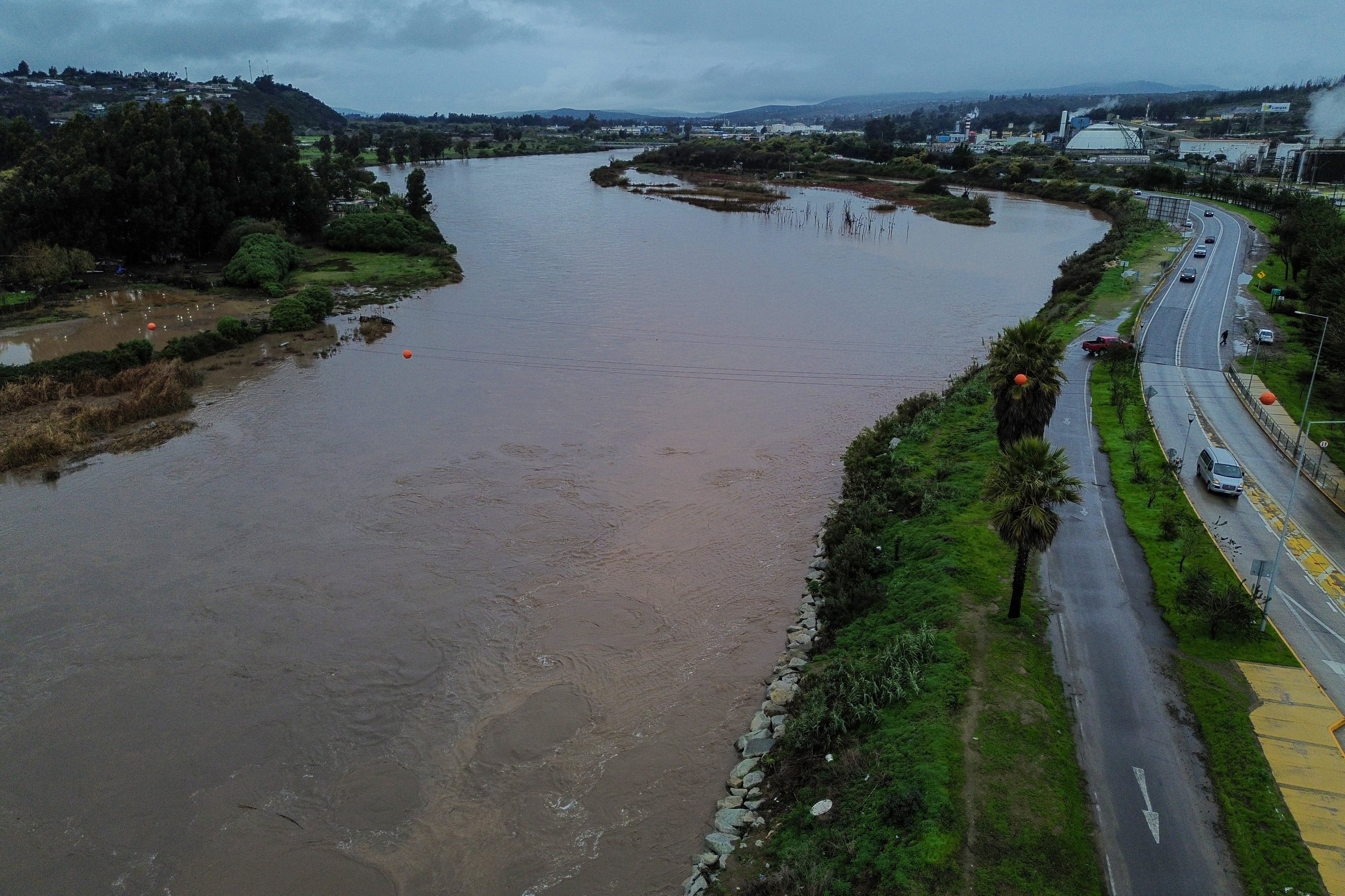
The recent passage of front systems through Chile has left a mixed legacy, with damage to infrastructure and housing, but also a much-needed hydric relief that several regions had not seen in years. In areas of Valparaíso, Atacama, and Coquimbo, the rainfall has approached what would typically be gathered over five years or more, reviving dry riverbeds and restoring flow to rivers that had remained dormant. However, this relief is not enough to close the water deficit that has plagued the country.
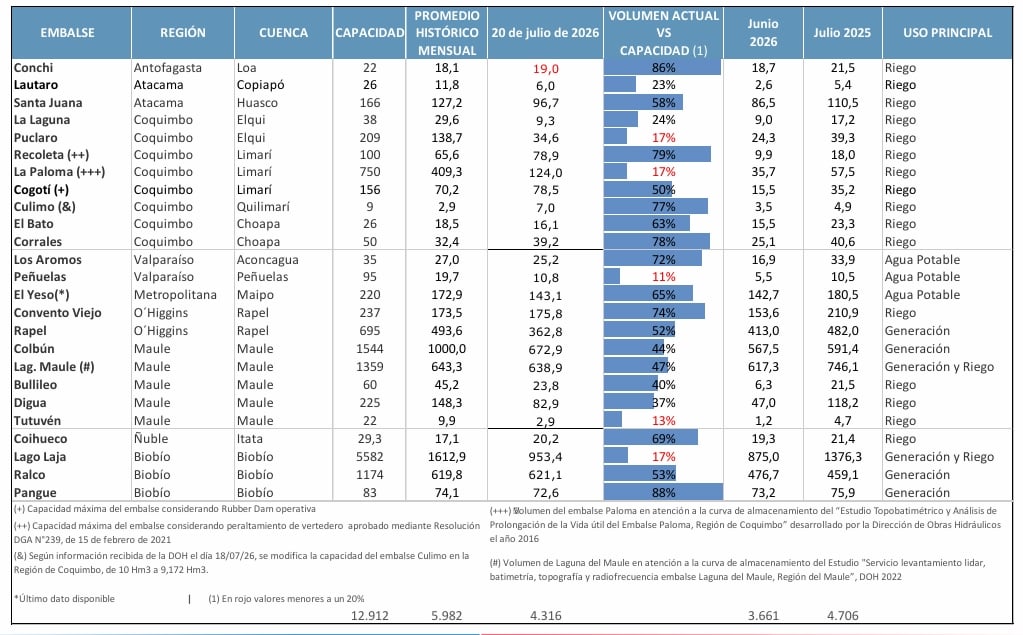
According to the hydrometeorological bulletin from the General Water Directorate (DGA), as of July 20, the national reservoirs hold 4.316 billion cubic meters, which is 8.29% below the 4.706 billion recorded at the end of July 2025 and significantly less than the historical monthly average of 5.982 billion from 1991 to 2020.
The system monitored by the DGA includes 25 reservoirs across nine regions with a total capacity of 12.912 billion cubic meters, of which 64% is dedicated to irrigation, 16% to electricity generation, 12% for drinking water, and 8% for mixed use.
However, July showed a significant improvement compared to the end of June, when the stored volume was 3.661 billion. In recent weeks, the front systems contributed an additional 655 million cubic meters of water, a welcome boost that, albeit significant, does not reverse the negative trend that has persisted for years.
Reservoirs in Critical Condition
According to the DGA report, five reservoirs are filled to less than 20% of their capacity, located in the regions of Coquimbo, Valparaíso, Maule, and Biobío. La Paloma and Puclaro are at just 17% of their capacity, while Lake Laja—the largest reservoir in the system with a capacity of 5.582 billion cubic meters—only reaches 17% with 953.4 million accumulated. Peñuelas is at 11% and Tutuvén at 13%. The situation at La Paloma is particularly revealing: with a capacity for 750 million cubic meters, it holds only 124 million, reflecting the ongoing water scarcity in the northern region.
Conversely, Pangue in Biobío leads with 88% capacity, followed by Conchi in Antofagasta at 86%. In Coquimbo, where the DGA monitors eight reservoirs, Recoleta stands out at 79%, Corrales at 78%, and Culimo at 77%.
Improvement in the North, but Unfavorable Balance
Year-on-year comparisons indicate that nine reservoirs have seen an increase in their volumes over the past twelve months, while 16 others recorded a decline.
In Coquimbo, the Recoleta reservoir increased from 18 to 78.9 million cubic meters, representing a jump of 338.3%. Cogotí rose by 123%, and La Paloma advanced by 115.7%, while Culimo grew by 42.9%. In Atacama, the Lautaro reservoir experienced an 11.1% rise.
However, La Laguna in the Elqui basin dropped by 45.9% over the year; El Bato fell by 30.9%; Santa Juana lost 12.5%; Puclaro decreased by 12%, and Conchi dropped by 11.6%.
On a national level, the overall trend remains unfavorable: the reduction of Lake Laja, by 422.9 million cubic meters, from 1.376.3 to 953.4 million cubic meters in twelve months, exceeds the total net drop, which stands at 390.1 million.
Uneven Landscape at Meteorological Stations
The DGA bulletin, considering 78 meteorological stations, reveals a notable contrast between the north and the central regions of the country. In the northern macrozone, 16 of the 22 stations report surpluses compared to the historical average. Vallenar has accumulated 150 millimeters versus an average of 27.1; Ovalle has 209.4 millimeters against a mean of 69.5; and La Serena displays 117.1 millimeters, reflecting an 88.9% surplus.
Contrarily, in the central macrozone, 22 of the 29 stations report deficits relative to the historical average. In Santiago, the MOP station has 135.9 millimeters, which is 25.1% less than normal, while El Yeso shows a deficit of 32.3%. Critical cases are found in O’Higgins, with La Rufina at -55.2%, and in the Metropolitan Region, where Laguna Aculeo is at -54.7%.
In the southern macrozone, 18 of the 21 stations recorded higher precipitation than in 2025, though five show surpluses. Concepción has accumulated 403 millimeters with a 38.3% deficit, while El Llolly in Los Ríos shows a surplus of 19.6%.
While respite has arrived, the structural deficit persists. July’s rains have replenished critical reservoirs and blanketed mountains that seemed desolate, yet the historical average remains a distant goal. The real challenge, beyond this temporary relief, is maintaining a recovery that is not yet solidified and which, as demonstrated by the figures, faces inequality.
Below you can review the latest hydrometeorological bulletin from the General Water Directorate:
Featured Image: Los Aromos Reservoir | Photo: Agencia Uno
La entrada Recent Rainfall Offers Hope for Chilean Reservoirs, Despite Ongoing Water Deficit se publicó primero en El Ciudadano.
🔥 Ver noticia completa en ElCiudadano.cl 🔥