El Ciudadano
Original article: La recuperación del guanaco toma fuerza: Expertos articulan plan para proteger a la especie en Santiago
Having largely vanished from much of the Santiago mountain range due to hunting and habitat loss, the guanaco is starting to reclaim its place in the Metropolitan Region, a process that recently progressed with the first «Meeting for the Guanaco: presentation of experiences and collaborations for a key species in Andean ecosystems».
The event gathered authorities, scientists, universities, environmental organizations, and private sector representatives to coordinate a common strategy aimed at strengthening the conservation and repopulation of this iconic Andean species.
A significant outcome of the gathering was the engagement of over 20 institutions in the Declaration of Action for the Guanaco, a commitment to establish a lasting collaboration network among public entities, academic institutions, civil society organizations, local communities, and the private sector to promote concrete actions for the recovery of the species and its mountainous habitats.
This initiative forms part of the program «Nature Tourism in the Network of Sanctuaries of the RM using the guanaco as a flagship species,» driven by the University of Chile and the Network of Nature Sanctuaries of the Metropolitan Region, with support from the Government of Santiago and the Rewilding Chile Foundation.
The program aims to restore the populations of Chile’s largest terrestrial herbivore, whose presence is crucial for the regeneration of wetlands, high Andean grasslands, seed dispersal, and ecological balance within the mountain range.
During the event’s inauguration, Santiago’s governor, Claudio Orrego, emphasized that the recovery of the guanaco is integral to positioning the Metropolitan Region as a nature tourism destination.
«If we want to make Santiago the capital of mountain tourism, we must also respect the region’s biodiversity. In this regard, we are working to regenerate nature. The guanaco is a flagship species for the RM due to its role in the ecosystem as a ‘gardener’ of the Andes, but also as prey for equally important species like the puma. This repopulation program is essential because it brings back a key player that should never have left the ecosystem,» he stated.
The meeting also provided an opportunity to report the tangible progress of the Guanaco Repopulation Program.
Recently, a new breeding nucleus was established at the El Plomo Nature Sanctuary in the Lo Barnechea commune, involving the introduction of one male and two females. This marks the completion and launch of three Guanaco Breeding Centers for conservation within the Metropolitan Region, enhancing efforts to recover viable populations of the species.
In this context, Sara Larraín, president of the Network of Nature Sanctuaries of the Metropolitan Region, highlighted that the recovery of the guanaco represents an ecological restoration measure with broader benefits that extend beyond the conservation of just one species.
«Repopulating the Santiago mountain range with guanacos that we recently caused to disappear is a significant restoration action that allows for the regeneration of wetlands, sustains pumas, condors, and other Andean wildlife,» Larraín noted.
«It also protects small local livestock operations and creates new jobs based on restoration and tourism. The collaboration among institutions agreed upon today to protect the guanaco marks a major step towards restoring mountain ecosystems, where rivers, glaciers, and wetlands are crucial for Santiago’s water security and irrigation of the Maipo Basin. Protecting the mountains is essential for safeguarding both people and the city, especially in Santiago,» the ecologist added.
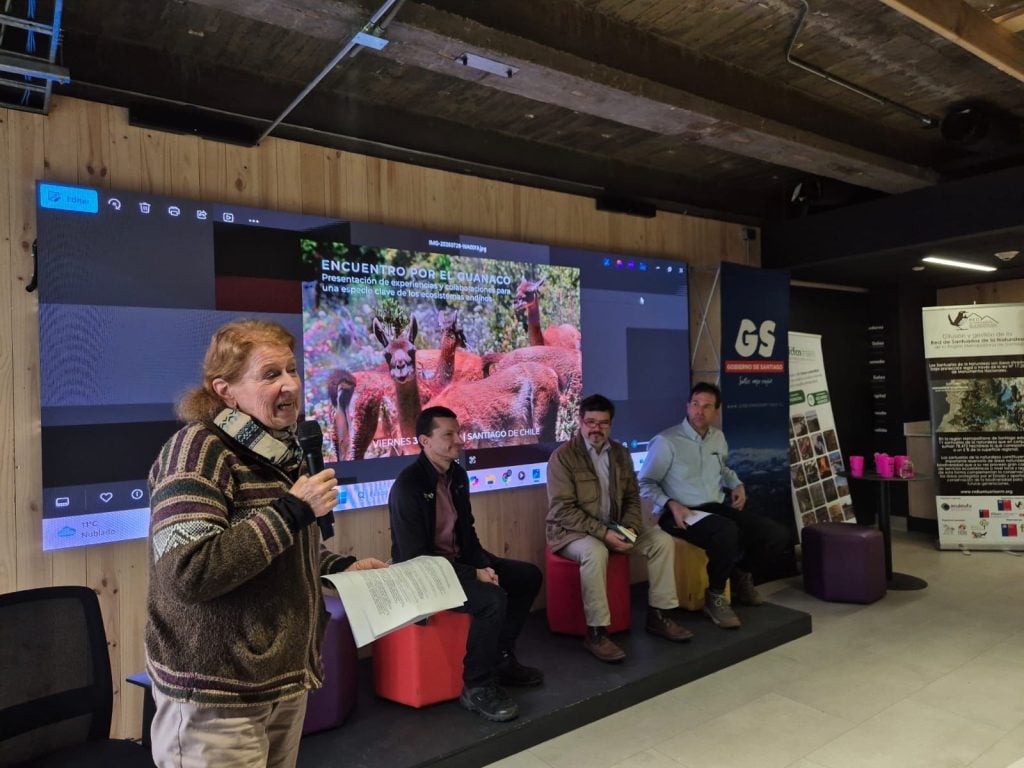
In Situ and Ex Situ Conservation Experiences
Throughout the day, specialists discussed conservation experiences both in situ and ex situ, population management, ecological restoration, and territorial planning, agreeing that the recovery of the guanaco requires ongoing coordination among institutions to ensure ecological connectivity in the mountain range and to establish new populations of the species.
Benito A. González, director of the Guanaco Repopulation Program and an academic at the Faculty of Forest Sciences and Nature Conservation at the University of Chile, noted the meeting as the start of a new phase for guanaco conservation.
«The significance of all this will be recognized in the future. We hope that in retrospect, we look back at this work as a turning point in conservation, especially concerning the actions being undertaken for this species,» he emphasized.
Similarly, Cristián Saucedo, director of the Wildlife Program at Rewilding Chile, indicated that the meeting showcased a broad base of institutions eager to collaborate in the recovery of the species.
«Through this meeting, we realize that there is a critical mass of diverse actors from the private and public sectors, as well as academia, who see the urgency and necessity to advance habitat recovery actions for the guanaco, as well as generate nuclei where the repopulation efforts can focus through a collaborative model aimed at action for this key Andes species,» Saucedo remarked.
Finally, the organizers highlighted that the Declaration of Action for the Guanaco will remain open for new institutions to join, with the aim of solidifying a long-term alliance that accelerates the recovery of this emblematic species and strengthens the conservation of the high Andean ecosystems in the Metropolitan Region, which are essential for biodiversity, water supply, and the climate resilience of Santiago.
We will continue to report on this topic.
Photo Credit: Franco Davico for Rewilding Chile.-
La entrada Revival of the Guanaco: Experts Unite to Protect This Key Species in Santiago se publicó primero en El Ciudadano.
🔥 Ver noticia completa en ElCiudadano.cl 🔥