El Ciudadano
Original article: Estrenan memoria audiovisual de la Escuela de Mediación de Cine Treile Media para educadores de La Araucanía
From Icalma, Pitrufquén, Chol-Chol, Cunco, Villarrica, Loncoche, Puerto Saavedra, Freire, Padre las Casas, and Temuco, teachers, educators, and artists from the La Araucanía region gathered every Saturday throughout November and December 2025 in various spaces converted into houses for film education in Temuco.
With the collaboration of Dibri UFRO, Txempeyem, Mapuzuguletuaiñ, Extensión UCT, Filmoteca, and the memory site Miraflores 724, the sessions began with Diego Olivares, coordinator of Filmoteca UFRO, who provided an overview of cinema and its «technological lineage» or materiality, encouraging reflection on the importance of preserving family and community archives from regional perspectives.
The second session welcomed filmmaker Juan Cáceres, director and screenwriter of the feature films «Perro Bomba» and «Kaye,» his latest film featuring young girls from a significant land occupation in Cartagena.
Following this, Mapuche educator Silvia Calfuqueo shared her experience of over 15 years with the Mapuche School of Cinema and Communication Aylla Rewe Budi, showcasing the short film ‘Taiñ Rvpv / Our Path’ in the first module dedicated to the use of Mapudungun in audiovisuals.
Calfuqueo proposed teaching methodologies for using the Mapuche language, reflecting on its significance for those living in ancestral Mapuche territory, culminating in a short filmmaking exercise using cell phones with Mapudungun words known by each participant.
Additionally, experimental and authorial Mapuche cinema was presented through the work of filmmaker Kati Antivilo, who showcased her short film «The Root of My Days.» She conducted an exercise involving sound memory, bringing forth the sensitivity and imagery tied to those memories, as well as the various ways to express them through cinematographic and audiovisual work.
«I try to create impure images that become more expressive. What matters is how the themes are approached,» stated the photographer and editor.
On the other hand, regional audiovisual representation was highlighted by visual anthropologist Nabil Rodríguez, an experienced academic who presented the documentary trilogy «The Value of the Seed: Poñi, Ancestral Seed»; «Pewen Milanario of Icalma»; and «Kingwa and Crop Diversity,» sharing participatory research and the importance of working with knowledge and relevance to the territory inhabited.
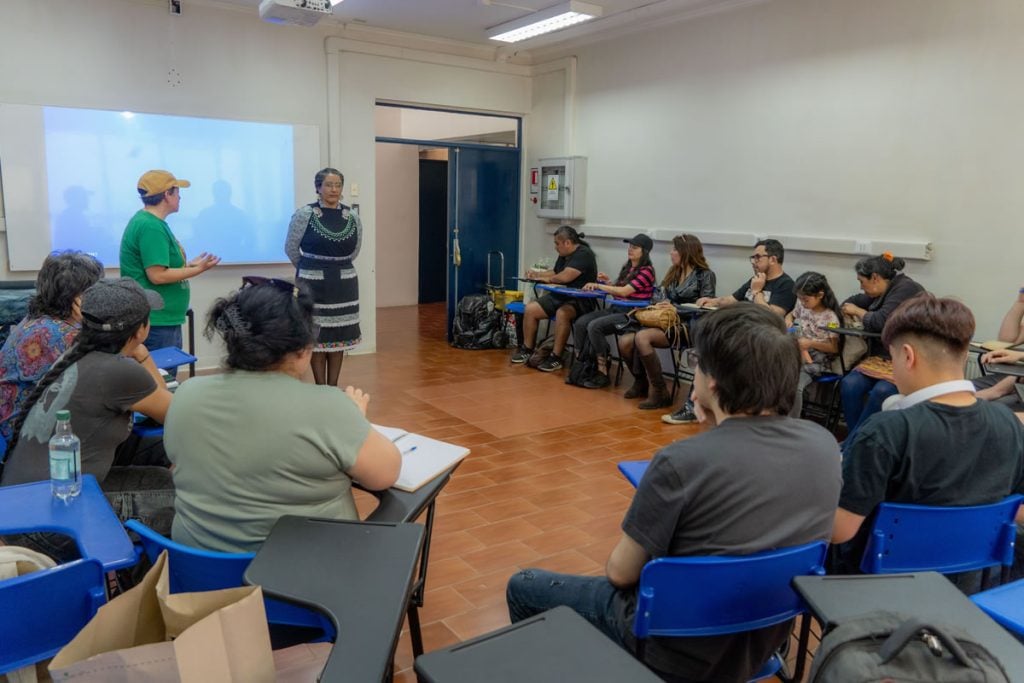
Use of Mapudungun
The use of Mapudungun in audiovisuals entered its second module with Mapuche educator Paula Huenumilla, who shared the experience of the Mapudungun language Institute Mapuzuguletuaiñ and Txempeyem, along with strategies for incorporating Mapudungun into daily life.
An example of this is the capsule «Oh, chemu am petu txuyufimi ti kuntxo? (2019),» where they dubbed the iconic scene from «Maldita Lisiada» into Mapudungun, aiming to «break the very sacred perception that some individuals had of Mapudungun back in those years.»
The final module, titled «Learn to Appreciate, Appreciate by Creating: Stop Motion,» had an initial part facilitated by Lorena Salas, a sociologist, anthropologist, and audiovisual creator, who presented methodologies for creating participatory scripts.
Subsequently, Tanu Araya, an editor and audiovisual creator based in Temuco, introduced the stop-motion technique, resulting in the short film ‘Opilión,’ co-created by the participants in this training. It critiques the consumption system and explores possibilities of life amidst the capitalist crisis.
Interculturality is Not Cultural Imposition
The project benefited from the intercultural pedagogical support of Jaqueline Caniguan, a Mapuche linguist, researcher, and academic, who emphasizes that intercultural relations are understood as interactions, dialogues, and connections between people or groups from different cultures, promoting conversation, respect, and equity while avoiding cultural imposition and acknowledging marginalized groups.
This aspect was particularly highlighted in this experience, “as there were participants of Mapuche descent as well as non-Mapuche participants, who work within a Mapuche context and whose life stories reflect Chilean cultural practices, making the constant promotion of intercultural relationships during the activities integral to the work proposal.”
The team behind the Film Mediation School, created by the audiovisual production company Treile Media, includes Ange Cayuman as general coordinator and co-producer; Morín Ortiz in communications and co-production; Felipe Cona in audiovisual realization; Valentina Veechi in administration; Mawun Pichinao in graphic design; and Jaqueline Caniguan as intercultural pedagogical advisor.
This project was funded by the Audiovisual Promotion Fund for public training in audiovisual mediation, call 2025.
Watch the Audiovisual Memory of the Treile Media Film Mediation School: Ruka ñi kimngepeyüm negumad dungu / The House to Learn about Films.
La entrada Treile Media Launches New Audiovisual Archive for Educators in La Araucanía se publicó primero en El Ciudadano.
🔥 Ver noticia completa en ElCiudadano.cl 🔥
