El Ciudadano
Original article: Verónica de Negri: «La consecuencia de instalar el olvido como política de Estado es el gobierno fascista que padecemos hoy»
By Jean Flores Quintana | El Ciudadano
Three years have passed since my last interview with Verónica de Negri. In July 2023, Chile marked the 50th anniversary of the coup under Gabriel Boric’s presidency, a period marked by hope, skepticism, and disappointment.
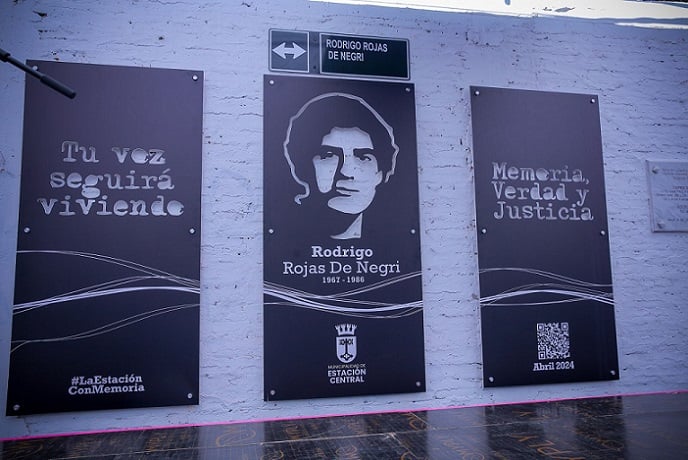
Now, in July 2026, amid an intense week of commemoration for the 40th anniversary of the murder of her son, Rodrigo Rojas de Negri, the woman who mobilized international attention and rejected Hollywood from using her life to whitewash the role of the United States in the dictatorship, entered the Cafetería Popular. She was accompanied by photographer and documentarian Gabriela Cruz.
Jean Flores Quintana (JFQ): Verónica, July 6 marks the exact day of Rodrigo’s death, and Valparaíso embraces it from its roots. Neighbors from Cerro Mariposas and the community of Colegio Pablo Neruda are raising a tribute at its entrance. Rodrigo was born in the port, grew up in Cerro Bellavista, and dreamed of a different world in those classrooms between 1973 and 1976. What emotions arise in you as you receive this demonstration of affection walking through your hometown?
Verónica de Negri (VdN): It’s very difficult to articulate how touching it is. You see, the Pablo Neruda school didn’t know about Rodrigo’s existence until the Musa collective created the mosaic. They wanted him to be honored in a place where his significance would truly be appreciated. I told them I respected the artist, and my suggestion was that Rodrigo should also be recognized in Valparaíso. I spoke with the school director where he studied, and they opened their doors for us. Even kindergarten children have been motivated to work around his life.
If you had seen the drawings, the compositions… I spoke with one mother from the parents’ council, and she said it’s incredible how these kids envision Rodrigo’s figure. They not only created the logo but named their musical group “Rodrigo Rojas de Negri” and called their student center by his name. What can I say? There are no words to appreciate it fully.
JFQ: The current scenario feels suffocating: José Antonio Kast’s mandate aligns with a regional conservative reconfiguration. In the face of state terrorism, you forged networks of international solidarity. Against this new threat, what is the fundamental tool that citizens must wield today to protect their rights and prevent any setbacks?
VdN: We must start by not insulting each other, by trying to understand one another. Even if a person thinks completely differently or behaves wildly, we must be able to dialogue and make them feel part of the community.
One of the largest functions of the dictatorship was to make us disappear as a collective. They denied our history. They invented Plan Z, staged various events, built lies about our tortures, deaths, and disappearances. That was dehumanizing and made our relationship as a people poorer every day. We must be able to speak with our neighbors, with those we share the bus with. If we don’t, we remain in this ever-growing tunnel; we stay in darkness while others destroy our lives by denying us rights.
We have always been kind and supportive, unlike them.
JFQ: Reconnecting and overcoming the distrust sown in the late eighties posed an immense obstacle for the organizations…
VdN: We must do this, or we will disappear. The change ahead of us is going to be so brutal that we can hardly imagine it. If we do not take the attitude of coming close, of learning to love one another again and focusing on what kind of society we want, we are lost.
We must shed the individualism imposed on us by the Concertación. That is the reality: the Concertación imposed and deepened the consumerist model to its benefit.
JFQ: We face a global landscape of wars where documenting the truth is vital. Rodrigo felt the urgency to wield his camera to show popular resistance against state terrorism. In light of the courage exhibited by correspondents and citizens risking their lives in contemporary conflicts, what values from your son’s work do you see reflected there?
VdN: Rodrigo deeply loved humanity and its struggles. Since childhood, seeing me involved in solidarity with Palestine, he developed immense interest and formulated his own conclusions about injustice. If Rodrigo were alive today, he would likely be in Gaza documenting genocide with his camera; perhaps he would have been killed again.
His curiosity spanned geography, music, and science. I used to buy him National Geographic magazines. One night, while researching the Caribbean, he adamantly rejected Puerto Rico’s colonial condition. He investigated and forged his own convictions. He was a brilliant kid.

JFQ: Your journey embodies the historical strength of thousands of Latin American women who have transformed intimate grief into an unbreakable trench. Today we witness a hostile reality: various administrations carry out systematic disinvestment against human rights organizations. In the face of this siege, how does that collective conviction empower the defense of dignity?
VdN: Throughout history, it has been women who have been at the forefront of change. Those of us who are serious about this injustice cannot stand idly by feeling pity. Even with pain, we use it to project positively and find a way out of this tunnel since this tunnel has existed for centuries. There are always solutions along the way.
We have a worldview and are not selfish: we want a country where children are happy, and no one endures what we experienced. Because that is a sickness.
JFQ: In 2024, you achieved a significant victory with the definitive ruling by the Supreme Court. You always place hope in the new generations. What reflections of Rodrigo’s humanistic vision do you see in the youth who are now holding assemblies in the territories?
VdN: Rodrigo was a very happy child during the Popular Unity and suffered greatly with the Coup. He understood what was happening more clearly than many adults.
There is something of which we do not talk: how children were affected. Some parents felt very important and ran away; others were marked with the letter L that prevented our return. In all those groups, there were children who were uprooted. They were severed from their center.
Rodrigo had many conflicts with me, believing that it was my fault he lost his life in Chile, where he was so happy. We forget that. He came to understand this only at the end, during our last call on June 30, when he told me: «Well, I finally understand you.»
He wanted all children to be happy. If you look at his photos, most of them relate to students, youth, and children.
JFQ: Unfortunately, oblivion has been established as State policy.
VdN: Exactly. They attempted to draw the false premise of recovering democracy with a pencil and paper, cementing the entire concertationist plot. The direct consequence of enshrining oblivion as State policy is evident: we now endure a fascist government. Those who lead the country act like criminals with a Nazi agenda. Just remember the deaths in Paine directly linked to their family; they lack any scruples.
Gabriel Boric claimed to represent the left, but his mandate paved the way to hand the country over to the criminal we have now. We need to build a brave political force willing to generate the urgent transformations that the people of Chile demand.
JFQ: Verónica, Rodrigo’s documentary legacy and your tireless struggle always advocate for new generations. What message do you have for the youth who resist in 2026?
VdN: The youth carry the weight of taking the leap to start seeing the light, and we must avoid at all costs repeating the mistakes of the past. They must not lose confidence; there are many elders like me who applaud and defend them without hesitation.
JFQ: They are our historical legacy.
VdN: Exactly. We are the living memory.
La entrada Verónica de Negri: «The Consequence of Enshrining Oblivion as State Policy is the Fascist Government We Endure Today» se publicó primero en El Ciudadano.
🔥 Ver noticia completa en ElCiudadano.cl 🔥