El Ciudadano
Original article: ¿Quién responde por la masacre en una escuela de niñas de Irán? Exigen que EE.UU. rinda cuentas y determine responsables
Amnesty International Demands Justice for U.S. Attack on School in Iran
- In-depth investigation
- The United States violated international humanitarian law by failing to take all possible precautions to avoid harm to civilians
- The United States is responsible for the deadly attack on a school filled with children that resulted in 168 fatalities
- U.S. authorities must ensure that the investigation is transparent, thorough, and that its findings are made public.
Those responsible for planning and executing the unlawful U.S. attack on a school in Minab, Hormozgan province (Iran), which killed 168 individuals — including over 100 children — must be held accountable, Amnesty International stated today.
Evidence gathered by the organization indicates that the school building was directly struck, along with 12 other structures belonging to the Islamic Revolutionary Guard Corps (IRGC), using guided munitions. This suggests that U.S. forces did not take all feasible precautions to avoid civilian casualties, constituting a serious violation of international humanitarian law. The direct assault on a school building, previously part of the IRGC complex raises concerns that U.S. forces may have relied on outdated intelligence and failed to verify whether the intended target was a military objective.
“This heartbreaking attack on a school full of children is a grotesque example of the catastrophic and entirely predictable price paid by civilian populations during this armed conflict. Schools should be safe havens for children, but this school in Minab became a site of mass death. U.S. authorities could — and should — have known that this was a school building. Attacking a protected civilian object, such as a school, is strictly prohibited by international humanitarian law,” stated Erika Guevara-Rosas, Amnesty International’s Senior Director of Research, Advocacy, Policy, and Campaigns.
U.S. authorities must ensure that the investigation they have announced is impartial, independent, and transparent. Investigations into the attack must examine the intelligence collection and assessments, targeting decisions, and precautions taken, as well as how AI may have been used in these processes, to evaluate how targeting decisions were made. The findings of the investigation must be made public.
When sufficient evidence exists, competent authorities must prosecute anyone suspected of criminal responsibility. Victims and their families have the right to truth and justice, and must receive full reparations, including restitution, rehabilitation, and compensation for the harm inflicted on the civilian population.
“If the attackers did not identify the building as a school and proceeded with the attack, it would indicate gross negligence in their planning and reveal a shocking intelligence failure in U.S. armed forces, as well as a severe violation of international humanitarian law. Conversely, if the U.S. was aware that the school was adjacent to the IRGC complex and attacked without taking all possible precautions — such as striking at night when the school would have been empty or effectively warning the civil population likely to be affected — the act would amount to recklessly launching an indiscriminate attack that caused deaths and injuries among civilians and must be investigated as a war crime,” said Erika Guevara-Rosas.
“On their part, Iranian authorities should immediately evacuate civilians from the vicinity of military targets wherever possible and allow independent observers into the country. They should also restore internet access to ensure that the 92 million people residing in Iran have access to vital information and can contact their loved ones.”
Video recordings, satellite imagery, and interviews with three independent sources with direct knowledge of the situation in Minab indicate that an airstrike hit the Shajareh Tayyebeh primary school on the morning of February 28, 2026, causing deaths and injuries among the civilian population — children, parents, and teachers — as well as severe damage and destruction. The school accommodated both girls and boys, who received classes in separate floors.
Amnesty International’s analysis of audiovisual evidence from the missile strikes against the adjacent IRGC complex and remnants of missiles reported by state media in Iran indicates that a U.S.-made Tomahawk missile was likely used in the attack. Only U.S. forces utilize Tomahawk missiles, which are precision-guided munitions.
The school was attacked individually as part of a broader strike against 12 other structures within the adjacent IRGC complex, raising serious concerns that it may have been targeted based on outdated intelligence. The New York Times reported on March 11, 2026, that a preliminary investigation by the U.S. armed forces determined that the attack on the school resulted from the use of outdated data.
Any current or future use of artificial intelligence increases the risk of such failures. On March 11, 2026, Brad Cooper, the commander of U.S. Central Command (CENTCOM), confirmed that the U.S. was using advanced AI tools to process large amounts of data related to operations.
The apparent reliance on outdated intelligence data — which did not reflect the prolonged designation of Shajareh Tayyebeh primary school as a civilian object — would constitute a serious violation of the precautionary principle, particularly the obligation to do everything possible to verify that a targeted object is military. After the attack, media and other organizations were able to quickly verify that the building housing the school had been separated from the rest of the complex since at least 2016. This indicates that parties in the conflict, possessing advanced intelligence-gathering capabilities and technology, should have been in a position to collect and verify this same information, which should have led to the decision not to attack the school.
Following the attack, Iranian authorities have exploited the suffering of victim families and surviving minors for propaganda purposes.
Methodology
Amnesty International’s Evidence Lab analyzed over 30 satellite images of the school and the adjacent IRGC complex, including images captured after the attack and historical images dating back more than a decade. The organization examined 28 videos and 30 photographs published online, including images showing the strikes against the IRGC complex, photos of munition remnants, and videos and images showing the immediate aftermath, rescue efforts, and body recoveries on-site. An independent forensic pathologist conducted additional analysis.
The organization also reviewed official statements issued by authorities in Iran, Israel, and the United States, as well as reports from state and independent media, and interviewed three people residing outside the country who had knowledge of the situation in Minab, the school, and the attack: a faculty member, a resident of Minab, and a Baloch human rights defender.
Amnesty International was unable to speak directly with witnesses or family members of the victims due to the deliberate internet blackout imposed by Iranian authorities since February 28, 2026.
Children and Teachers Killed and Injured in Airstrike on a School
According to U.S. authorities, the airstrikes by Israeli and U.S. forces on February 28, 2026, began throughout Iran at 9:45 AM local time.
In a media interview, Mohammad Ashouri, governor of Hormozgan province, stated that Shajareh Tayyebeh primary school was attacked one hour after military operations started, at 10:45 AM local time.
Amnesty International spoke with Sohrab (a fictitious name for security reasons), a resident of Minab, who informed the organization that he had contacted four independent sources with direct knowledge of the attack on the school. He reported that the school staff began to alert parents around 10:00 AM to come pick up their children. This decision evidently preceded a national alert issued (about 15 minutes later) by Iranian authorities announcing the closure of all schools in the country.
The organization also spoke with Shiva Amelirad, an international representative of the Iranian Teachers’ Coordination Council, who relayed information from two independent sources knowledgeable about the school and the attack.
Shiva Amelirad and Sohrab reported that when many families arrived at the school to pick up their children, the attack had already occurred. Sohrab told the organization:
“People from nearby streets and those who had the time rushed and tried to pick up the children whose families had not yet arrived. A large part of the student body was from neighboring villages, and transportation was slow; those who lived farther away had to wait for a vehicle from their town. That wait was deadly. The principal and teaching staff stayed at the school to evacuate the children. Most died. No one imagined they would attack a school within the city.”
Iranian authorities reported that 168 people died in the attack. On March 3, 2026, the Mizan news agency, linked to the judiciary, announced that at least 110 students were among the deceased — 66 boys and 54 girls — as well as 26 teachers and four parents. On March 7, 2026, authorities published a collage featuring images of 119 deceased children. Due to the ongoing internet blockade and the lack of access to the country to inspect the site and interview affected individuals, Amnesty International cannot independently verify the death toll.
Location of the School Next to a Military Complex
Amnesty International’s investigation found that the school is located in the Shahrak-e Al-Mahdi neighborhood of Minab and is adjacent to a military complex belonging to the Seyyed al-Shohada Asif Missile Brigade of the IRGC’s naval force responsible for coastal defense in southern Iran. The complex is a military installation housing multiple buildings. There is also a medical center — Shahid Absalan specialized clinic — belonging to the Health Command of the IRGC Navy, enclosed by walls within the complex.
Shiva Amelirad and Sohrab informed Amnesty International that the school served both children of IRGC personnel and low-income families from the area, including members of the oppressed Baloch ethnic minority in Iran.
The analysis conducted by Amnesty International on satellite images dating back to 2013 shows that the current school building was previously included within the perimeter of the IRGC complex, though it was later walled off and separate public entrances were created.
Satellite images from 2016 indicate that the school facilities — in the northeastern part of the complex — had been physically separated from the IRGC complex by perimeter walls and three closed separate entrances. Satellite images captured in 2017 and 2018 show that the grounds and walls were decorated with designs and colors similar to other local schools. Between 2023 and 2025, two satellite images taken on school days reflect fresh paint on the grounds and people present at the entrances.
According to Shiva Amelirad, the school building had previously served as the command headquarters of this IRGC complex before becoming a school several years ago. Amnesty International has not been able to determine the date when the building transitioned to being a school.
Satellite and Video Analysis of the Attacks on the School and the IRGC Complex
Satellite images taken at 10:23 AM local time on February 28, 2026, indicate that at that moment the school and the IRGC complex remained standing without visible damage, suggesting that the attacks occurred afterward.
Iranian state authorities announced that the attack occurred at 10:45 AM. Videos posted online around 11:49 AM and 12:00 PM show thick smoke rising from the direction of the IRGC complex.
Analysis of satellite images from March 2 and 4 reveals destruction at the school site and the IRGC complex. Satellite images from March 4, 2026, show that the western half of the school building is destroyed. A large pile of debris is evident, as well as damage or destruction of at least 12 structures within the adjacent IRGC complex. The school building is located approximately 74 meters from the closest struck structure in the adjacent IRGC complex.
Videos from the scene show a characteristic cascading roof collapse, which serves as evidence that an airstrike affected much of the school building.
Additionally, several videos published on February 28, 2026, capture the immediate aftermath of the attack on the school.
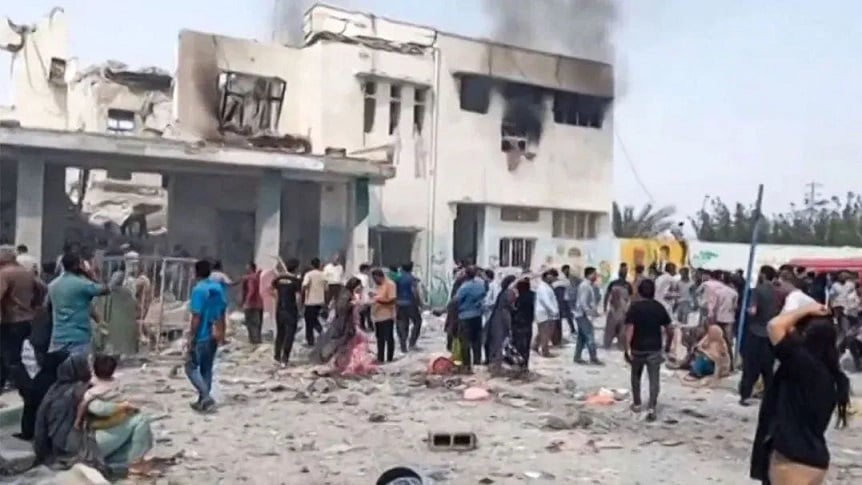
The video of the school grounds recorded after the attack shows the brightly painted walls separating the school from the IRGC compound and playground markings on the ground. On the western side of the school, the building appears to have been largely reduced to rubble. The eastern side, still standing, shows severe damage, with thick smoke rising from its interior.
The videos and images posted online show that, following the attack, the schoolyard was quickly filled with dozens of men and women who helped remove debris. Other videos show that the rescue efforts involved members of the Iranian Red Crescent and others, including men in camouflage uniforms similar to those of the IRGC and its Basij battalions, as well as several trucks and excavators.
Several videos showcase dozens of children’s backpacks covered in dust recovered from one area, some stained with what appears to be blood. In one video, visibly distressed women can be seen next to the backpacks while an excavator clears debris in the background. Another video shows multiple people standing around the rubble, beneath which a part of a human body can be seen. According to a forensic pathologist consulted by Amnesty International, this appears to be a forearm that seems to have been traumatically amputated. The size of the hand and forearm, compared to the visible adult men in the images, indicates they likely belonged to a minor. A video filmed later in the afternoon shows a man standing among the debris holding a hand and an amputated forearm. According to the forensic pathologist, these remain covered in dust, and the lacerations are consistent with blast trauma. It is also highly likely they originated from the body of a minor.
A video filmed inside one of the classrooms shows debris on the benches and desks. The green benches and window frames, along with the visible wall decorations, match the style of other parts of the school, indicating that the destroyed section of the building was utilized for educational purposes.
A video published on March 8, 2026, by Iran’s state news agency Mehr News Agency and verified by Amnesty International shows the impact of a missile on the IRGC complex. Further analysis of the images indicates that it is highly likely that a subsonic Tomahawk cruise missile, discernible by its distinctive wings and large square fins, was used. Images indicate that this specific missile did not impact the school. The video also captures a column of gray smoke rising in the northeastern part of the complex, which could have originated from the school or adjacent IRGC buildings.
On March 9, 2026, the state broadcaster, the Islamic Republic of Iran Broadcasting (IRIB), aired images of what appear to be missile fragments consistent with a Tomahawk missile found. The IRIB claimed that the images belonged to “the remnants of a missile that fell on the children at the school in Minab.” While this debris would further corroborate that parts of the complex were hit by at least one Tomahawk missile, Amnesty International cannot independently verify whether the school was attacked by similar munitions.
During a press conference at the Pentagon on March 2, 2026, Dan Caine, Chairman of the Joint Chiefs of Staff, confirmed that the U.S. Navy had fired Tomahawk missiles on February 28, 2026, in southern Iran. During another press conference on March 4, 2026, Dan Caine displayed a map of the locations targeted by U.S. and Israeli forces during the initial 100 hours of military intervention, which included Minab. When asked about the attack on the school, Defense Secretary Pete Hegseth stated that the Pentagon was investigating the incident.
During a press conference on March 9, 2026, responding to a journalist’s inquiry regarding the likely Tomahawk missile that struck the school, U.S. President Donald Trump asserted that “Iran or someone else” was to blame for the attack.
On March 10, 2026, a White House spokesperson confirmed that investigations into the attack on the school were ongoing and that the U.S. Department of Defense would be releasing a comprehensive report.
International Humanitarian Law
International humanitarian law requires conflict parties to at all times distinguish between combatants and military objectives, on one side, and civilians and civilian property on the other. It is prohibited to directly attack civilians and civilian property, such as schools. Only combatants and military targets may be the object of attack.
Conflict parties must also adhere to the precautionary principle, which requires a constant effort not to cause harm to civilians and civilian objects during military operations, including taking all possible precautions to minimize loss of civilian life, injuries to civilians, and damage to civilian property during attacks.
Consequently, they must do everything possible to verify that the targets are military, which includes conducting rigorous intelligence gathering and analysis and verifying all available information about a target. If at any point during their planning or execution it becomes evident that the target is not military, or that the attack would be disproportionate, it must be cancelled or suspended. Conflict parties must ensure that meaningful human control is maintained during the use of artificial intelligence in planning and carrying out attacks.
Conflict parties must also take all possible precautions in selecting weapons, tactics, and means of an attack, including the timing of the attack, to avoid or minimize incidental harm to civilians and damage to civilian property, and to give effective prior warning of attacks that may affect civilian populations, unless circumstances do not permit.
Moreover, international humanitarian law demands that conflict parties take all possible precautions to protect civilians and civilian property under their control from the effects of attacks. This includes moving, wherever possible, the civilian population and civilian property away from military objectives. Therefore, Iranian authorities should not have located the school in a building adjacent to an IRGC complex, which is regarded as a military target during armed conflict and was itself attacked.
Authorities Exploit Minors and Coerce Families for Propaganda Purposes
Testimonies and videos collected by Amnesty International also reveal that Iranian authorities forced families of deceased minors to participate in funerals that did not conform to their traditions and used surviving traumatized children for state propaganda.
According to Sohrab, the authorities informed families that all bodies of deceased minors would be placed in coffins and included in a single mass funeral organized by the state on March 3, 2026, during which Shia Muslim prayers would be recited, even though some victims and their families belong to the Sunni Baloch minority of Iran, who observe different religious rites. When some families expressed their desire to conduct funerals in accordance with their religious traditions, authorities responded that this would not be allowed. Sohrab reported that families were told they would not receive the remains of their children until after the mass ceremony.
Additionally, authorities have taken surviving minors to the ruins of their school, where they filmed videos for propaganda despite visible injuries and trauma. In one video published online on March 5, 2026, a journalist interviews two visibly distressed girls — apparently aged between 7 and 11 years — and repeatedly prompts the younger girl to mention her deceased friends and say which ones she loved most. The young girl names her friends and states she loves them all. She adds that the mother of one of her friends, who was a teacher, also died, and then breaks down in tears.
In another video, a 10-year-old girl with a visible facial injury is questioned during the mass funeral about the death of her 11-year-old brother. This interview aired on state media on March 6, 2026.
These acts of coercion, intimidation, and exploitation of grieving families and traumatized survivors cause severe psychological distress and could violate the absolute prohibition against torture and other cruel, inhuman, or degrading treatment or punishment.
U.S. Congress Should Ensure Ongoing Initiatives to Mitigate Civilian Harm
Essential systems implemented in recent years based on the work initiated by the first Trump administration to better reduce and respond to civilian harm caused by lethal U.S. actions abroad are threatened by the current Trump administration. Reports indicate that the Department of Defense’s programs focused on mitigating and responding to civilian harm have been dismantled, and that the U.S. president has removed restrictions on military commands authorize certain types of airstrikes and special operations. Defense Secretary Pete Hegseth has dismissed key military lawyers responsible for ensuring compliance with international humanitarian law in military operations.
Additional Information
On February 28, 2026, the United States and Israel launched a joint military operation in Iran. Since then, thousands of strikes have occurred throughout the country. Iranian authorities have retaliated with strikes across the region. The armed conflict has rapidly escalated, resulting in regional hostilities throughout the Middle East. Additionally, it has led to a significant loss of civilian life and the destruction of civilian infrastructure. In response to Hezbollah attacks, Israel has also intensified its strikes against Lebanon.
To date, reports indicate that at least 1,255 people have died in Iran, over 773 in Lebanon, at least 12 in Israel, and at least 17 in other countries in the region.
On March 7, 2026, the director of the Information and Public Relations Center of Iran’s Ministry of Education announced that at least 66 schools across Iran had been damaged or destroyed, resulting in student fatalities in several of them. On February 28, 2026, a schoolchild died in the playground of Imam Reza primary school in Abyek, Qazvin province, after a nearby attack shattered windows and caused debris to fall in the yard. CCTV footage captured the incident.
In a statement on March 12, eight UN experts called for an independent investigation into specific attacks that could constitute severe violations of international humanitarian law, referencing the attacks on the school.
La entrada Who Will Be Held Accountable for the Massacre at an Iranian Girls’ School? Calls for Justice and Accountability from the U.S. se publicó primero en El Ciudadano.
🔥 Ver noticia completa en ElCiudadano.cl 🔥