El Ciudadano
Original article: El precio de una complicidad: Colombia y la diplomacia de los fosfatos saharauis
By Hafdala Chadad Brahim, Sahrawi lawyer and diplomat
Foreign policy decisions can stem from strategic reasons, economic interests, or even ideological shifts within governments. However, there are choices that lead to a much more uncomfortable question: What happens when economic and mercantilist interests overshadow the principles that should guide foreign policy and international law?
The recent policy shift by the Colombian government under Abelardo De la Espriella regarding Western Sahara falls into this uncomfortable category.
On August 7, 2026, the new Colombian government announced its recognition of Morocco’s sovereignty over Western Sahara, alongside a freeze of relations with the Sahrawi Arab Democratic Republic (SADR), reversing the approach taken during Gustavo Petro’s administration.
Simultaneously, Bogotá unveiled a new phase of relations with Rabat that focuses on enhancing trade, investments, tourism, food security, port infrastructure, and Atlantic connectivity. [1]
The alignment of these two moves should not go unnoticed. Western Sahara is legally not part of Morocco.
A Territory Awaiting Decolonization
An elementary point that every Latin American government should acknowledge is that Western Sahara has been recognized as a Non-Self-Governing Territory by the United Nations since 1963.
More than six decades later, its decolonization process remains unfinished, with the Sahrawi people’s right to self-determination still unfulfilled. [2]
Moreover, the Advisory Opinion by the International Court of Justice on October 16, 1975, did not recognize any territorial sovereignty ties between Morocco and Western Sahara that could impede the principle of self-determination.
The court concluded that the evidence presented did not establish any territorial sovereignty links between the land of Western Sahara and the Kingdom of Morocco that would affect the implementation of resolution 1514 (XV) and, crucially, the right of the territory’s people to freely express their will. [3]
If the ICJ’s position in 1975 was already clear regarding the lack of territorial sovereignty affecting self-determination, subsequent jurisprudence from the Court of Justice of the European Union has been even more explicit.
In its ruling on December 21, 2016, the CJEU established that Western Sahara has a status that is separate and distinct from that of any State, including Morocco. [4]
This doctrine was reaffirmed in 2024. In the ruling of October 4, 2024, case C-399/22, the court noted that Western Sahara is a territory distinct from Morocco under EU law, and products originating from the territory must indicate Western Sahara as their origin rather than Morocco. [5]
Thus, this is not merely a political interpretation by the POLISARIO Front or the SADR, nor is it a subjective assessment by those who support the Sahrawi cause. It is a conclusion drawn from European jurisprudence about the application of international law to the territory.
And this raises a question that Colombia must address: If the Court of Justice of the European Union has established that Western Sahara constitutes a territory distinct from the Kingdom of Morocco, how can a Latin American state unilaterally recognize Moroccan sovereignty over that territory without conflicting with the principle of self-determination and international law?
The Judicial Precedent: Sahrawi Phosphate
There is a particularly revealing African judicial precedent. In May 2017, the vessel MV NM Cherry Blossom arrived at Coega Port in South Africa, carrying about 55,000 tons of phosphate extracted from the Bou Craa mine in Western Sahara, destined for New Zealand, where it was to be used for fertilizer production.
The Sahrawi Arab Democratic Republic and the POLISARIO Front went to South African courts to prevent the cargo from leaving the country’s jurisdiction while its ownership was legally determined.
On June 15, 2017, the High Court of Eastern Cape ordered that the cargo remain under the court’s jurisdiction and prohibited its removal while the ownership matter was resolved. The court found that the Sahrawi side had established prima facie a right justifying the retention of the cargo. [6]
The significance of the case went beyond the economic value of the cargo. The court faced a fundamental question: Can a company treat as its own a natural resource extracted from a territory whose international status remains pending decolonization?
Thus, the NM Cherry Blossom case became a particularly significant precedent regarding the exploitation and commercialization of natural resources from Western Sahara. [7]
We are not simply dealing with a political claim. An African court intervened to prevent a phosphate cargo from being treated as ordinary merchandise while ownership was determined. This precedent should be considered when discussing phosphates, fertilizers, and agricultural cooperation with Morocco today.
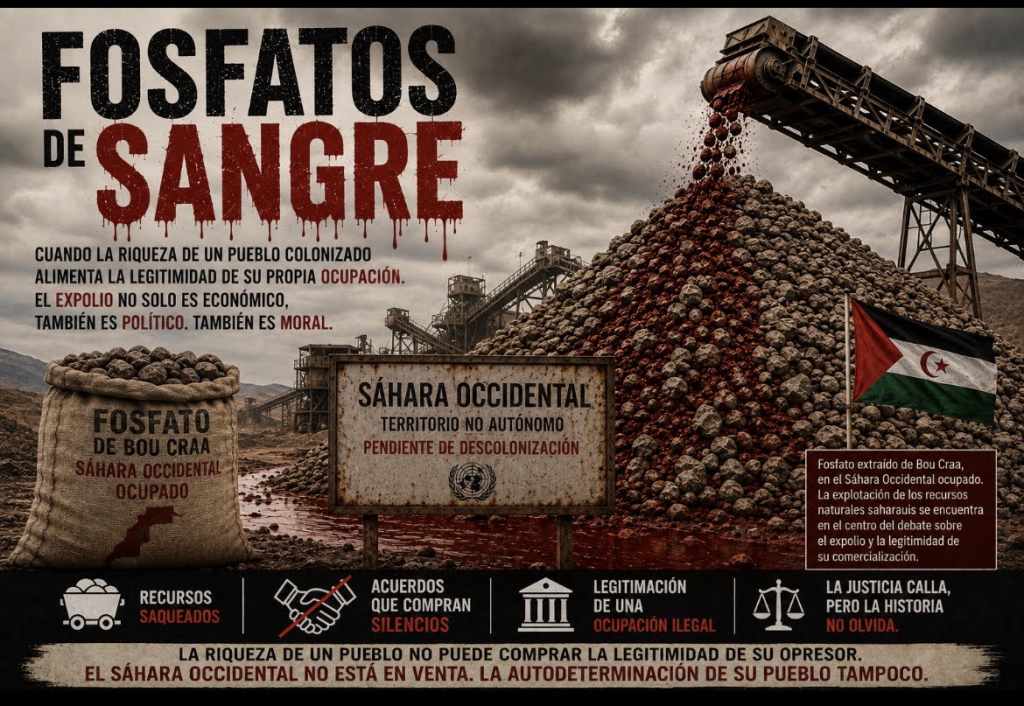
Because Sahrawi phosphate is not a legally neutral commodity. Behind every ton extracted from Bou Craa lies a prior question that no commercial contract can erase: Who has the right to control the natural resources of a territory that has not completed its decolonization process?
The answer is clear: Only the Sahrawi people have this right.
The Diplomacy of Fertilizers
At this point, another dimension emerges that deserves much more attention: the use of agricultural cooperation and fertilizers as instruments for economic and diplomatic rapprochement. Latin American examples are becoming increasingly visible.
In Peru, the 2022 official announcement from the Foreign Ministry regarding the diplomatic pivot towards Morocco explicitly mentioned agricultural cooperation and fertilizers as areas of partnership.
However, the Peruvian case requires precision: Pedro Castillo had restored relations with the SADR and later reaffirmed his stance on Sahrawi self-determination. The definitive break happened later under Dina Boluarte’s government. [8]
What occurred in Peru should not be presented as a simple linear operation between fertilizers and recognition. Its significance lies in illustrating how these economic instruments are linked to certain moments of diplomatic realignment.
In Ecuador, Morocco has developed agricultural cooperation programs that include the provision of fertilizers. [9]
In Guatemala, the government officially reported a Moroccan donation of 200 tons of fertilizers for small farmers. [10]
In Panama, agricultural cooperation with Morocco similarly includes the delivery of fertilizers. [11]
Bolivia also represents a relevant case due to its shift in relations with the SADR and the subsequent rapprochement with Morocco, accompanied by an agenda of economic and agricultural cooperation. [12]
It would not be serious to assert that every Latin American diplomatic change was directly purchased with fertilizers. Such a claim would require documentary proof of the causal relationship in each country. However, it would also be unreasonable to ignore the pattern.
Fertilizers. Phosphates. Agricultural cooperation. Investments. Economic agreements. And, simultaneously, significant shifts in the positions of certain Latin American governments regarding Western Sahara.
The issue is not to mechanistically claim that a donation produces recognition. The matter is much more uncomfortable: Can the economic wealth associated with a territory pending decolonization become a tool of political influence over third states?
Colombia: Can Economics Override the Constitution?
Colombia’s Political Constitution states in Article 9 that the state’s foreign relations are grounded in national sovereignty, respect for the self-determination of peoples, and recognition of the principles of international law accepted by Colombia.
It further adds that Colombian foreign policy will be oriented toward Latin American and Caribbean integration. [13]
This mandate becomes extraordinarily important in light of the current government’s decision. Colombia has not only frozen its relations with the SADR. It has explicitly recognized Morocco’s sovereignty over Western Sahara and simultaneously announced a new phase of cooperation with Rabat in areas such as trade, investments, food security, infrastructure, and connectivity. [1]
The inevitable question arises: How can the recognition of Moroccan sovereignty over a Non-Self-Governing Territory pending decolonization be reconciled with Colombia’s constitutional mandate to respect the self-determination of peoples and the principles of international law?
Colombia has every right to develop economic relations with Morocco. It can trade with Morocco. It can invest in Morocco. It can cooperate with Morocco. But none of these economic relations legally obligate Bogotá to recognize as Moroccan a territory whose international status remains pending decolonization.
Trade cannot substitute for law. Investment cannot substitute for self-determination. And economic cooperation cannot turn territorial occupation into a completed legal fact.
From Economic Exploitation to Diplomatic Complicity
The problem becomes particularly serious when the natural resources of a people subjected to occupation and a decolonization process are used to strengthen the political and economic relations of the de facto controlling power with third states, making them complicit in this occupation.
International jurisprudence has established clear limits. The International Court of Justice preserved the Sahrawi people’s right to freely determine their political future. [3]
The Court of Justice of the European Union has reaffirmed the distinct and separate character of Western Sahara from Morocco and linked the application of certain agreements to the territory with the requirements arising from the right to self-determination. [4] [5]
And the South African court that dealt with the NM Cherry Blossom case intervened judicially concerning a phosphate shipment from Bou Craa. [6] [7]
This gives rise to a vicious and perverse circle: Occupation → exploitation of resources → economic cooperation → diplomatic influence → political recognition → legitimization of the occupation. The exploitation ultimately contributes politically to the legitimization of the very exploitation.
And Colombia has now entered that debate with a decision that cannot be analyzed solely from the perspective of bilateral relations with Morocco.
However, this issue transcends Colombia. Latin America knows too well the history of colonialism, territorial occupation, and the exploitation of the natural resources of subjected peoples. Latin American solidarity with the Sahrawi people did not emerge from a diplomatic juncture, it arose from a shared historical experience: the struggle against colonialism, the defense of sovereignty, and the right of peoples to freely determine their destiny.
Thus, it would be a grave mistake to interpret the recent position changes of some Latin American governments as reflective of the sentiments of the peoples of Latin America. Governments come and go. Economic conditions change. Diplomatic alliances modify. But the principles of self-determination and decolonization should not become interchangeable commodities.
The situational decisions of certain Latin American governments, motivated by economic or mercantilist interests, cannot sever the historical bond of brotherhood and solidarity that connects Latin American peoples with the Sahrawi people.
The Sahrawi people do not need Latin America to do them a favor. They need Latin America to be consistent with the principles that it defended to achieve its independence.
Blood Fertilizers?
For decades, the international community learned to speak of “blood diamonds” to describe those natural wealth resources whose exploitation was linked to conflict, violence, and suffering.
The case of Western Sahara raises an uncomfortable question: Are we witnessing a new form of politically contaminated wealth?
Not because it can be asserted that every shipment of Moroccan fertilizers comes from occupied Western Sahara, nor because it can be proven that every Latin American diplomatic shift has been purchased. The issue runs deeper.
It concerns whether the wealth tied to a territory pending decolonization can be used to forge economic relationships, generate influence, and bolster diplomatic positions that ultimately support claims of sovereignty over the same territory from which that wealth originates.
It would be the most perverse paradox of contemporary colonialism: using the wealth of a colonized people to buy the political legitimacy of its own colonization.
When the natural wealth of a territory is employed to fuel political relationships intended to legitimize its occupation, we are no longer dealing solely with an issue of economic exploitation. We are facing the internationalization of complicity. And it is then that fertilizers cease to be merely fertilizers. They can turn into blood fertilizers.
For no donation, no commercial contract, no investment, and no shipment of fertilizers can purchase a people’s right to freely determine their destiny.
Let it be known to those born and those yet to be born: Western Sahara is not for sale. The self-determination of its people is not for sale either.
Hafdala Chadad Brahim, Sahrawi lawyer and diplomat
References
[1] Ministry of Foreign Affairs of Colombia, official statement on the freezing of diplomatic relations with the Sahrawi Arab Democratic Republic and the new framework for relations with Morocco, August 2026.
[2] United Nations, Special Committee on Decolonization, Western Sahara, Non-Self-Governing Territory.
[3] International Court of Justice, Western Sahara, Advisory Opinion, October 16, 1975.
[4] Court of Justice of the European Union, ruling on December 21, 2016, Council of the European Union v. POLISARIO Front, case C-104/16 P.
[5] Court of Justice of the European Union, ruling on October 4, 2024, Confédération paysanne v. Minister of Agriculture and Food Sovereignty and others, case C-399/22, ECLI:EU:C:2024:839.
[6] High Court of South Africa, Eastern Cape Division, Saharawi Arab Democratic Republic and Another v Owner and Charterers of the MV “NM Cherry Blossom” and Others, June 15, 2017.
[7] Judicial and jurisprudential documentation related to the case NM Cherry Blossom and the phosphate shipment from Bou Craa.
[8] Ministry of Foreign Affairs of Peru, official statement on relations with the Sahrawi Arab Democratic Republic and bilateral cooperation with Morocco, 2022–2023.
[9] Government of Ecuador, official information on agricultural cooperation and fertilizer delivery from Morocco.
[10] Government of Guatemala, official information on the Moroccan donation of fertilizers for small farmers.
[11] Ministry of Agricultural Development of Panama, official information on the cooperation program and fertilizer donation from Morocco.
[12] Government of the Plurinational State of Bolivia, information on the re-establishment of diplomatic relations with Morocco and the suspension of relations with the SADR.
[13] Political Constitution of the Republic of Colombia of 1991, Article 9.
La entrada The Cost of Complicity: Colombia’s Shift in Diplomacy Regarding Sahrawi Phosphates se publicó primero en El Ciudadano.
🔥 Ver noticia completa en ElCiudadano.cl 🔥